Tag: family

  • The Experiment – Chapter 5

    The Experiment – Chapter 5

    <- Previous Chapter | All Chapters

    Wednesday: Three Women

    Lakshmi woke before the alarm, the room still cool with early light. Parvathi slept on, one arm flung across the pillow, breathing deep in a way that meant she could afford another few minutes. Lakshmi watched her for a moment, then leaned in, pressed a soft kiss to her forehead.

    “You sleep a bit more,” she whispered. “I’ll keep everything ready.”

    She slipped out of bed quietly.

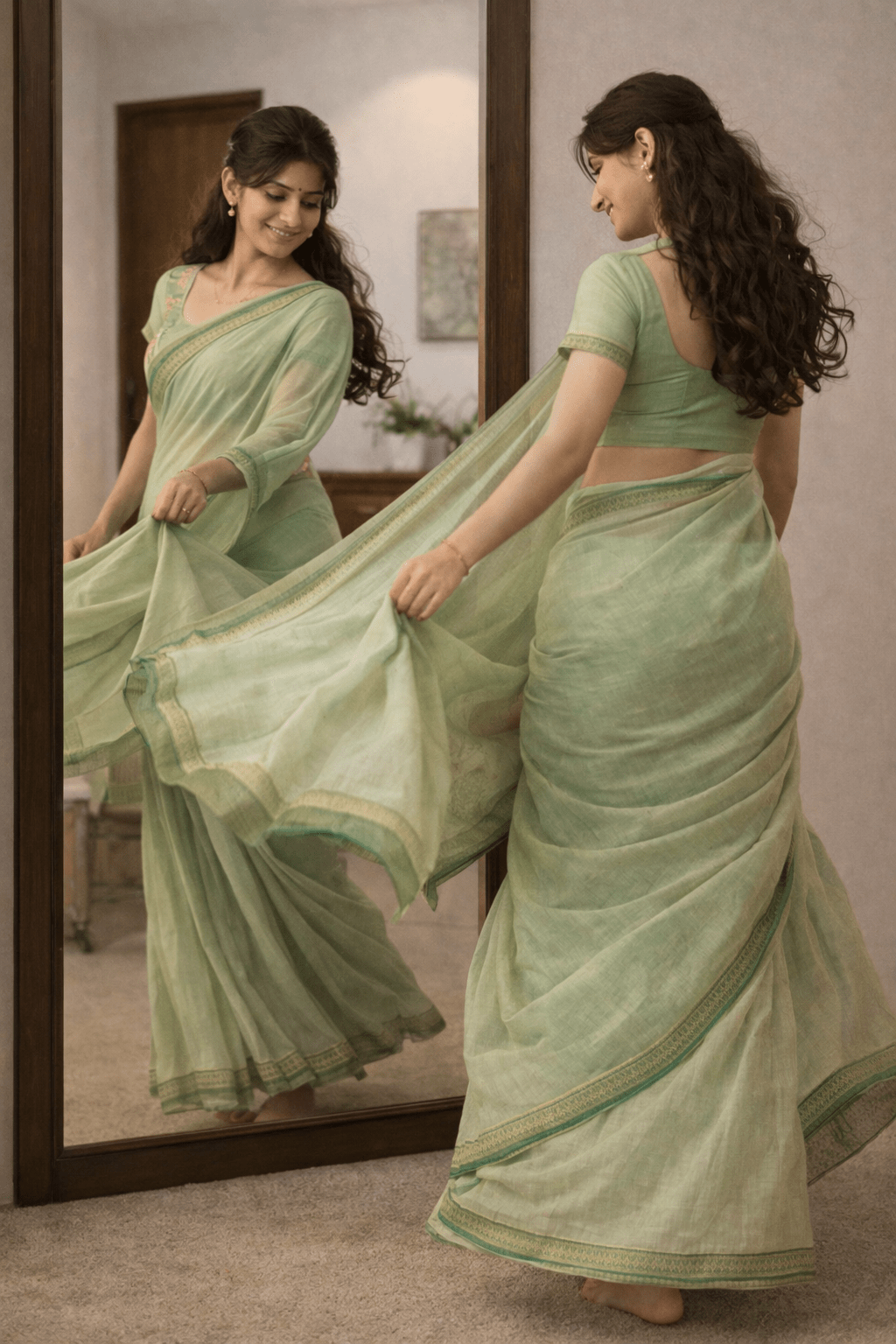
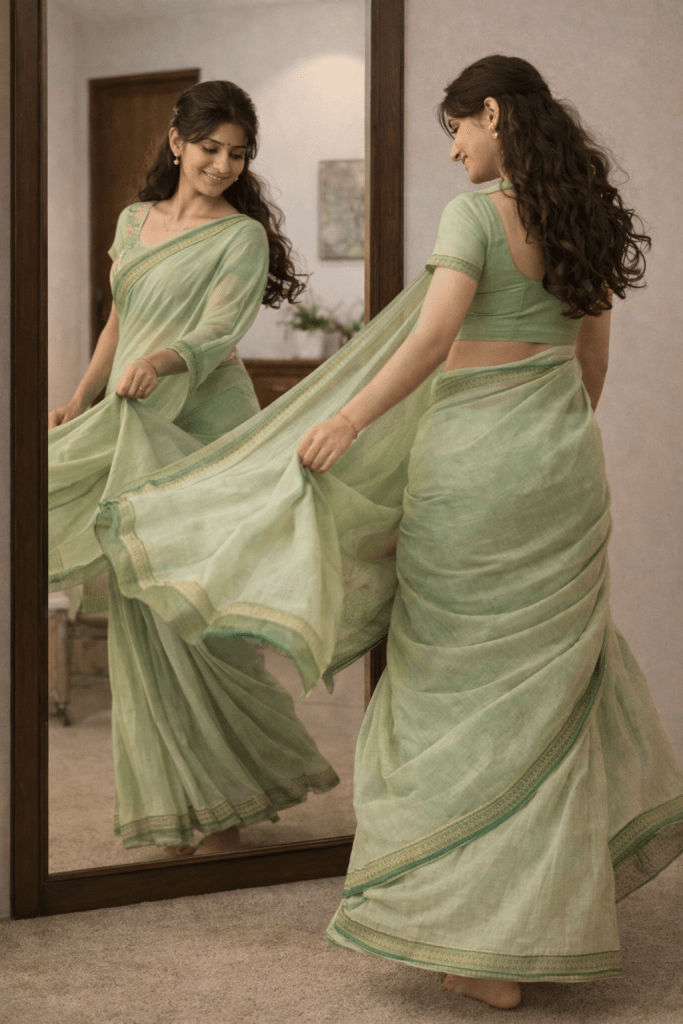
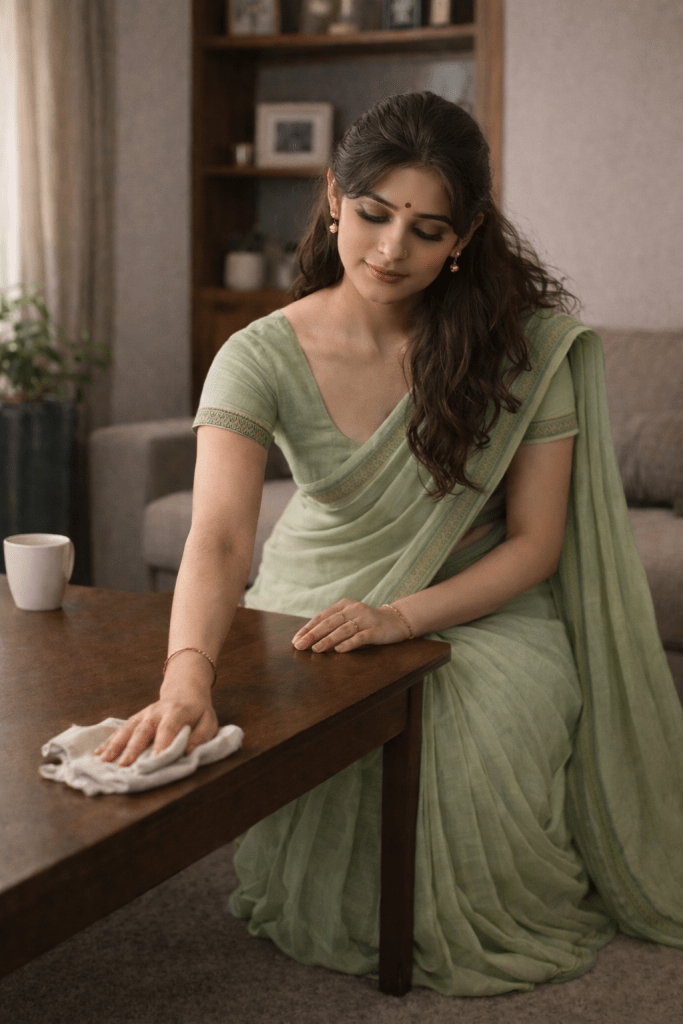
    At the cupboard, she paused longer than necessary. Wednesdays were not ceremonial days—no visitors expected, no errands planned yet. She chose a saree that matched that mood: a light polyester, pale green with a faint, repetitive pattern. Easy to drape, forgiving if she had to move fast, the kind of saree meant to disappear into the day rather than announce itself. The blouse was plain, short-sleeved, already familiar to her body.

    The shower was quick. Shaving was automatic now—underarms, legs, face—done without conscious thought. She dried her hair, tied it back loosely, and draped the saree with practiced efficiency. Two rehearsals, she reminded herself. Enough to justify competence, not enough to invite questions.

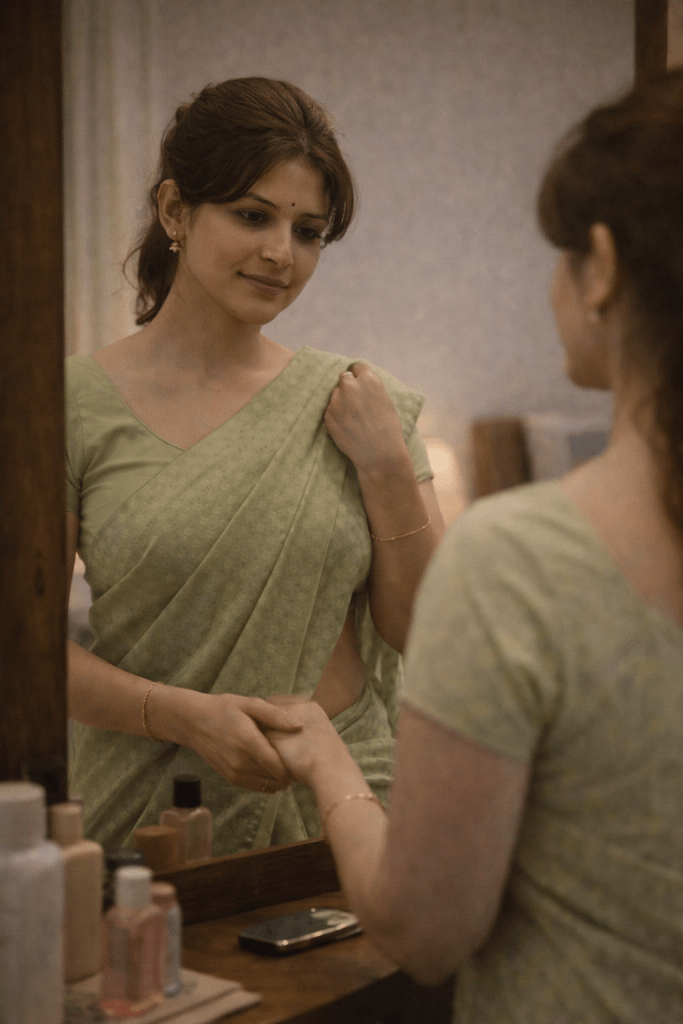
    In the mirror, she adjusted the pallu, smoothing it across her shoulder. This saree didn’t demand elegance; it allowed motion. Good for what she had planned.

    In the kitchen, she started breakfast. Poha today—light, fast. As mustard seeds crackled in oil, she checked the fridge.

    We should make some tomorrow, she thought. Good to have variety.

    She added it to the mental list forming already: batter, groceries, laundry, dinner prep.

    While the poha steamed, she packed lunch—leftover sambhar, palya warmed gently, and a note to fry papad later before boxing it. By the time everything was ready, sunlight had spilled fully into the bedroom.

    Lakshmi went back, sat on the edge of the bed, and brushed Parvathi’s hair away from her face.

    “It’s time,” she said softly.

    Parvathi stirred, smiled even before opening her eyes. “Already?”

    Lakshmi nodded. “Breakfast is ready.”

    Parvathi disappeared into the bathroom. When she came back, towel around her shoulders, she stopped short at the dining table.

    “Oh,” she said. “Poha?”

    “And eggs,” Lakshmi said, turning from the stove. “Lunch is packed too.”

    Only then did Parvathi really look at her.

    The indigo of yesterday was gone; this was quieter, domestic. The saree sat easily on Lakshmi’s frame, the pallu already tucked once at the waist, as if she had things to do and places to move through.

    Parvathi stepped closer and wrapped her arms around Lakshmi from behind. “I should have married you years ago.”

    Lakshmi laughed, nudging her gently. “Let me finish this first. Then you can hug.”

    Parvathi showered, dressed, and came back ready for work. They ate together, unhurried. Parvathi talked about meetings; Lakshmi listened, nodded, filed away times and moods.

    “You know,” Parvathi said finally, standing up to leave, “it feels like you’ve always lived here like this.”

    Lakshmi walked her to the door, handed over the lunchbox, adjusted the strap of Parvathi’s bag.

    “Have a nice day,” she said.

    When the door closed behind Parvathi, Lakshmi stood still for a moment—then turned back toward the house that was now hers for the day.

    Lakshmi didn’t sit down after the door closed. She stood in the hallway for a second, listening to Parvathi’s footsteps fade, then moved straight into the rhythm of the house.

    Calendar first.

    She opened it on her phone, scanning the day. Two meetings in the morning, one in the late afternoon. Nothing urgent in between. Enough open space to do something real.

    Laundry.

    She went to the bedroom and pulled out the baskets. One glance was enough to know what needed priority. Night dresses first—too many had been worn over the weekend, and she had promised herself she wouldn’t let them pile up again. Cotton sarees next. Kitchen towels. Bedsheets could wait; those didn’t need sun today.

    She sorted with care, hands moving automatically, but her mind stayed engaged. Some fabrics could take harsh sunlight; others needed shade to keep their color. A few delicate pieces she set aside entirely.

    Sun is strong today, she thought. Better to use it.

    She loaded the machine with the first batch—nightwear—measured detergent without checking the label, set the cycle, and moved on to the next pile while it ran.

    Between loads, she took her first meeting, camera off, voice steady and neutral. She answered when needed, took notes, listened more than she spoke.

    When the washing finished, she didn’t dump everything together. She hung the shade-safe clothes near the balcony first, spacing them carefully so air could move through. Saree pallus draped neatly, not twisted. Night dresses placed where they’d dry fastest.

    The terrace pile grew in a separate basket: cotton sarees, towels, heavier linens.

    I really need a trolley for this, she thought, lifting the basket slightly to test its weight. Or wheels.

    She added it to the list.

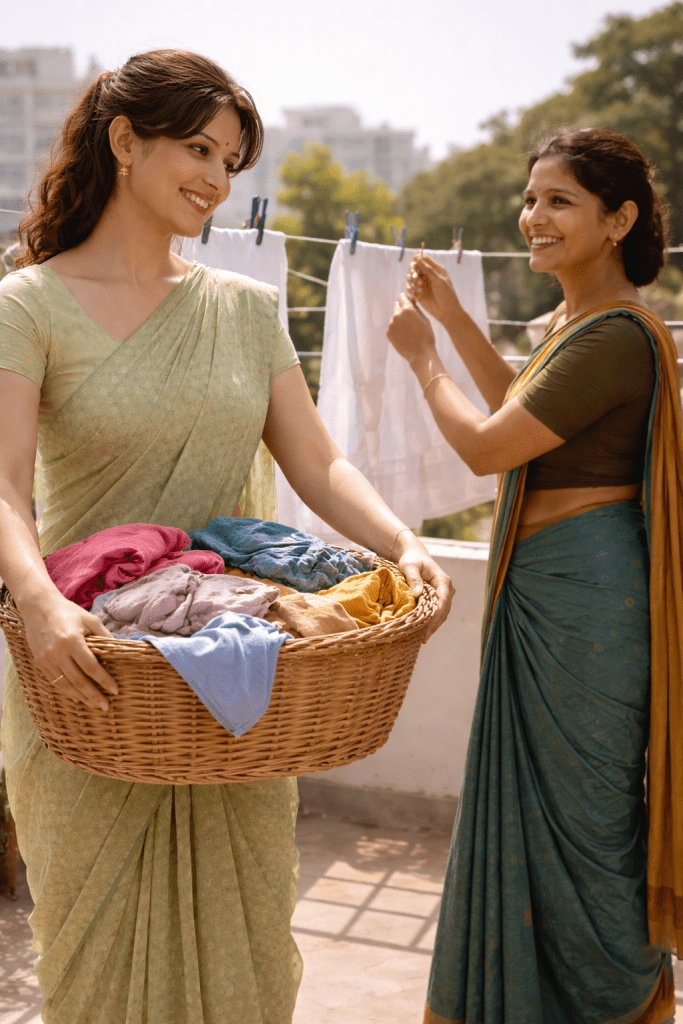
    Before heading up, she adjusted her saree—pallu tucked securely at the waist this time, pleats tightened. This was work, and her clothes reflected that. She carried the basket carefully, aware of balance, aware of the fabric brushing against her legs as she climbed.

    The terrace door opened into bright sunlight.

    Sheela was already there.

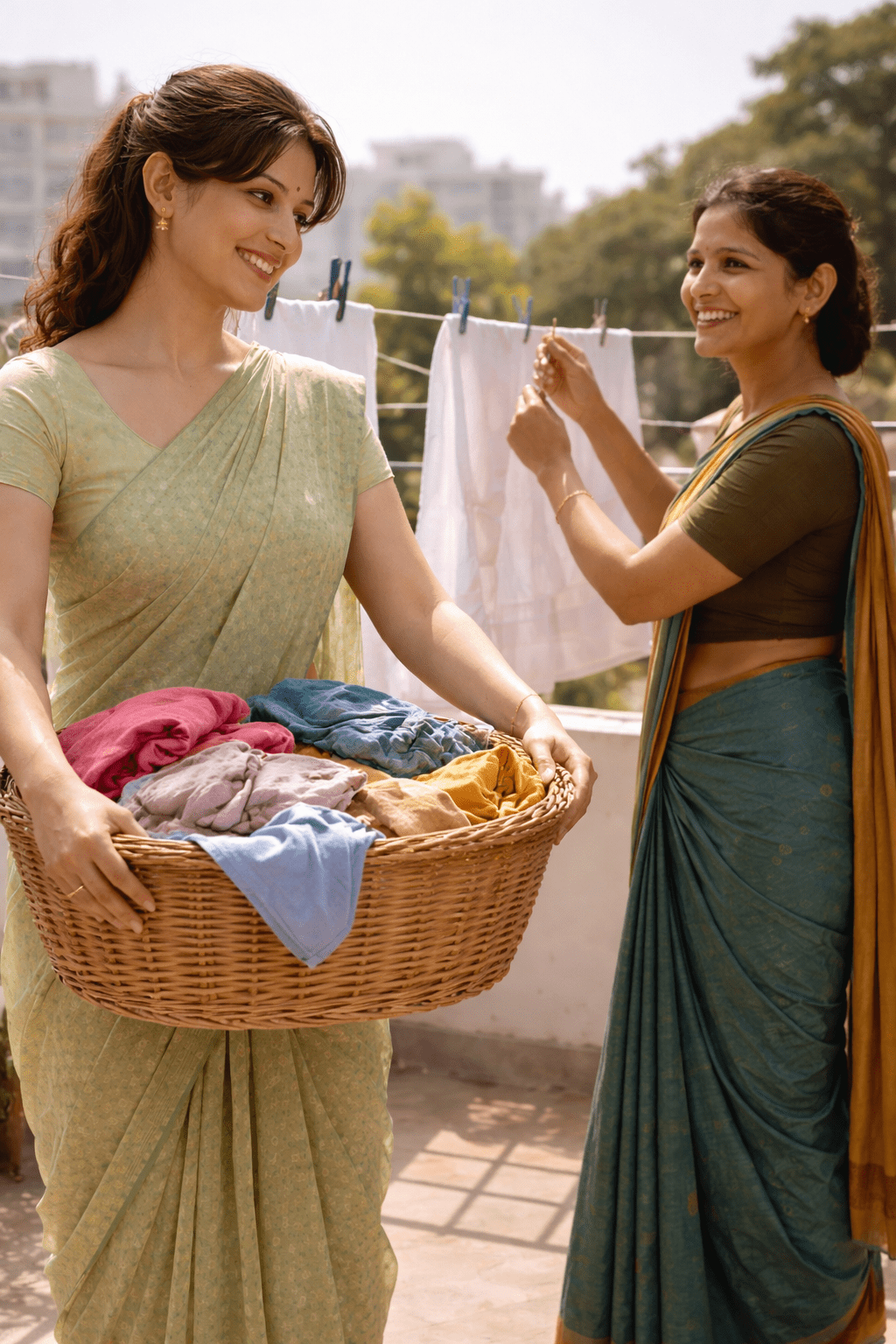
    Sheela stood near the railing, pinning up clothes with practiced speed, her own saree tied back almost identically. She looked up and smiled.

    “Good morning,” she said. “Laundry day?”

    Lakshmi smiled back. “Perfect weather for it.”

    She set the basket down and began hanging the first saree, smoothing it before fixing the clips. Sheela watched her for a moment longer than necessary.

    “You know,” Sheela said casually, “everything about you looks so convincing now.”

    Lakshmi paused, then continued pinning. “Convincing?”

    “Mm,” Sheela nodded. “The way you move. Even that”—she gestured to the tucked pallu—“that’s how women who actually work around the house do it. Not for show.”

    Lakshmi felt a quiet warmth spread through her chest. “Thank you.”

    Sheela leaned against the railing. “Honestly, if someone saw you here like this, they wouldn’t think twice. You look like every other housewife I’ve grown up watching.”

    They worked side by side for a few minutes in silence, the rhythm familiar, domestic, unremarkable in the best way.

    Then Sheela tilted her head slightly. “There’s just one thing.”

    Lakshmi felt it before Sheela said it.

    “Your voice,” Sheela continued gently. “Everything else has fallen into place so fast. But your voice still… sounds like Vishnu.”

    Lakshmi’s hands didn’t stop moving. “Yeah?”

    “If you want,” Sheela said, “I can help. It’s not hard. Just small shifts.”

    Lakshmi hesitated—only for a second. “I’m willing to learn,” she said. “What do I need to do?”

    Sheela smiled. “Good. First—relax your throat. Don’t push. Try saying this…”

    And just like that, between sarees and towels, the lesson began.

    They worked as Sheela spoke.

    “Don’t try to sound higher,” Sheela said, pinning a bedsheet. “That’s the mistake most people make. Just let the sound come forward.”

    Lakshmi nodded, repeated the sentence Sheela gave her. Slowly. Carefully.

    “No, slower,” Sheela said. “And don’t finish it so sharply. Let it trail a bit.”

    Lakshmi tried again. The words felt different leaving her mouth this way—lighter, less pushed. She adjusted without thinking, like she always did when copying someone else’s rhythm.

    “That’s better,” Sheela said. “Again.”

    They hung more clothes. Towels. A cotton saree. Kitchen cloths flapped in the breeze as Lakshmi repeated phrases, each time correcting something small—breath, pace, softness.

    “Relax your jaw,” Sheela added. “You’re holding tension there.”

    Lakshmi exhaled, tried again.

    This time Sheela smiled. “There. Did you feel that?”

    Lakshmi did. She nodded.

    They moved along the line, sunlight warming their backs. The lesson didn’t pause the work; it flowed with it. Instructions came between clothespins, corrections slipped in while walking to the next railing.

    “You’re picking this up too fast,” Sheela said after a while, laughing. “You’re dangerous.”

    Lakshmi smiled, careful not to overdo it. “I used to do a lot of mimicry in college,” she said lightly. “Actors, politicians… all male ones. This felt familiar.”

    “Well,” Sheela said, satisfied, “then I’m just giving you the final polish.”

    Lakshmi thanked her, sincerely. She didn’t mention the hours she’d spent alone, whispering into mirrors, adjusting syllables no one else ever heard. She was happy to let Sheela own the moment.

    By the time the last cloth was hung and they gathered the empty basket, Lakshmi noticed something quietly remarkable.

    She wasn’t trying anymore.

    They walked back toward the stairwell together, Sheela chatting about nothing in particular, and Lakshmi answering—naturally, easily, her voice settling into place as if it had always known where to rest.

    At the door, Lakshmi paused. “Have you met Meena yet?” she asked.

    Sheela shook her head. “The new neighbor?”

    “Yes,” Lakshmi said. “She’s just downstairs. Thought I’d introduce you.”

    Sheela smiled. “Lead the way.”

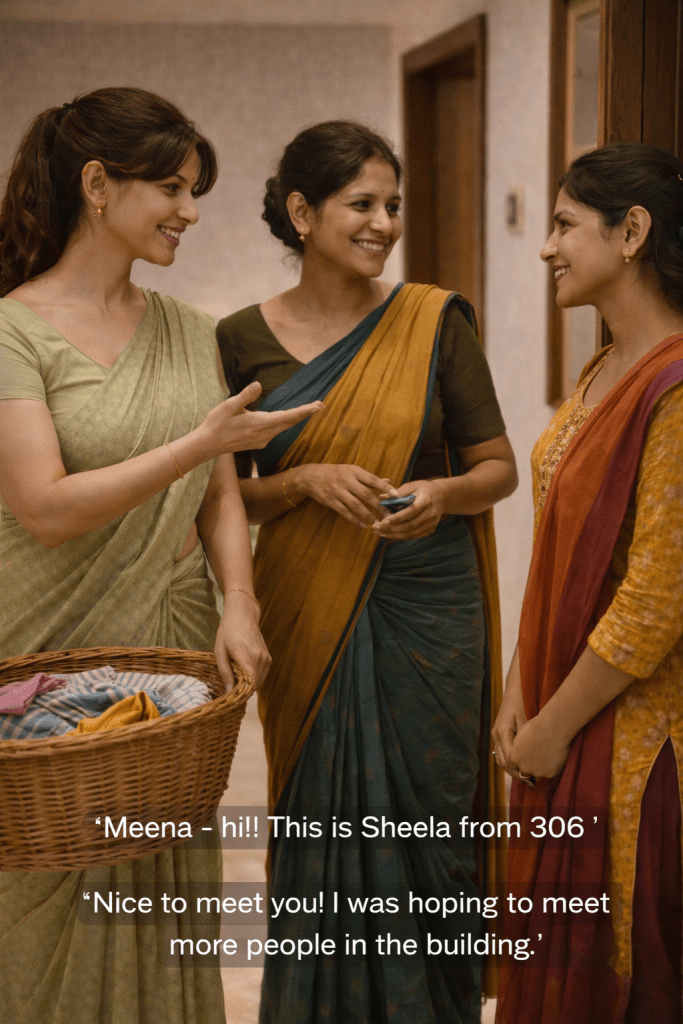
    Meena opened the door with a smile that came easily, the kind that suggested she was still trying to keep flat numbers and names straight.

    “Oh hi!” she said.

    “Meena – hi!” Lakshmi said, just as easily. “This is Sheela from 306.”

    Meena’s smile widened. She shifted her attention to Sheela. “Nice to meet you! I was hoping to meet more people in the building.”

    They stepped inside for a moment, the doorway becoming a small circle of conversation.

    Meena spoke about unpacking, about how everything she needed seemed to be in the wrong box. Sheela chimed in with advice—where to find the best vegetables, which shops delivered late, which days the water pressure dipped.

    Lakshmi listened, added a detail here and there, answered a question about the building association. Her voice stayed where it had settled upstairs—calm, forward, unremarkable.

    Meena didn’t pause or blink. To her, Lakshmi was exactly who she appeared to be: another woman in the building, competent, friendly, already part of the quiet network that made a place feel livable.

    “You should come for lunch sometime,” Lakshmi said before thinking too hard about it. “Today, if you’re free. Nothing fancy.”

    Meena looked genuinely pleased. “I’d love that.”

    Sheela nodded. “Perfect. Saves me from figuring out what to cook.”

    Back in Lakshmi’s kitchen, things fell into place quickly. The sambhar was already simmering; she added a second palya, fried papad while the rice steamed. Plates appeared on the table without ceremony.

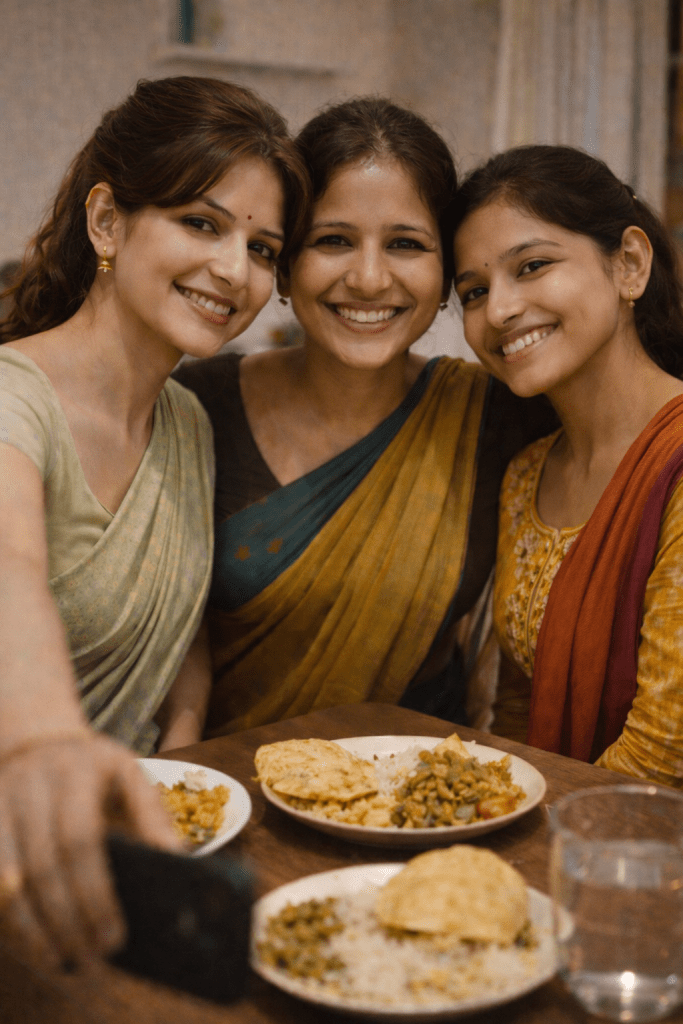
    They ate together, the conversation drifting—work, children, neighbors, how strange it felt to start over somewhere new. Lakshmi moved easily between kitchen and table, refilling glasses, clearing plates, her presence steady rather than showy.

    At one point, she held her phone up and snapped a quick photo of the three of them, smiling mid-meal. She sent it to Parvathi without comment.

    The reply came almost immediately.

    Oh no. You’re all meeting without me? Total FOMO. Say hi to Meena from me.

    Lakshmi smiled, typed back, then slipped the phone away.

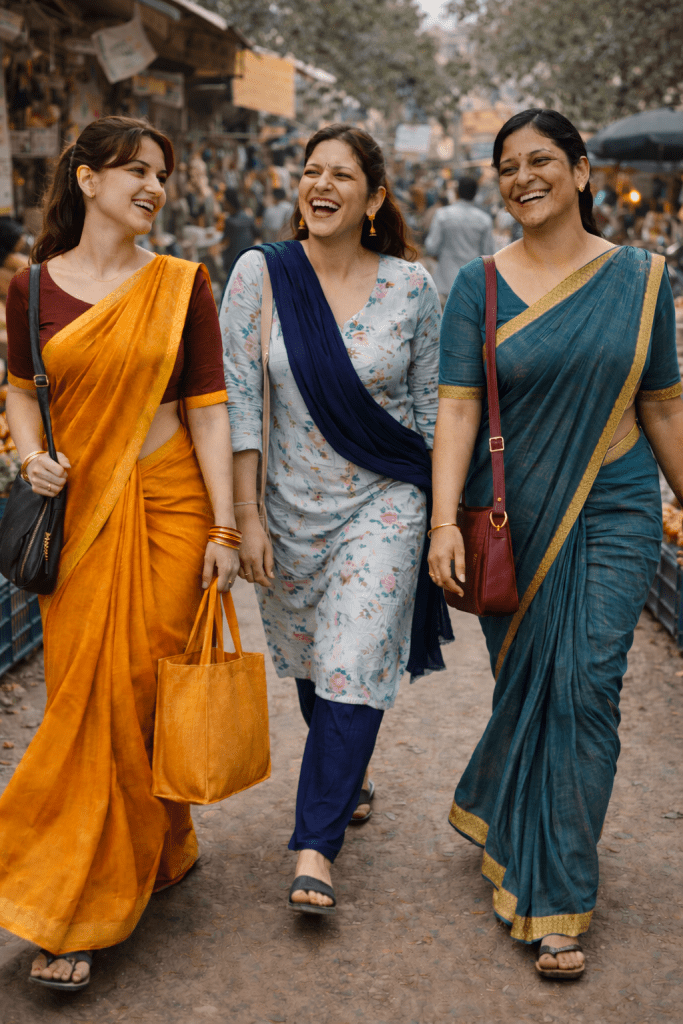
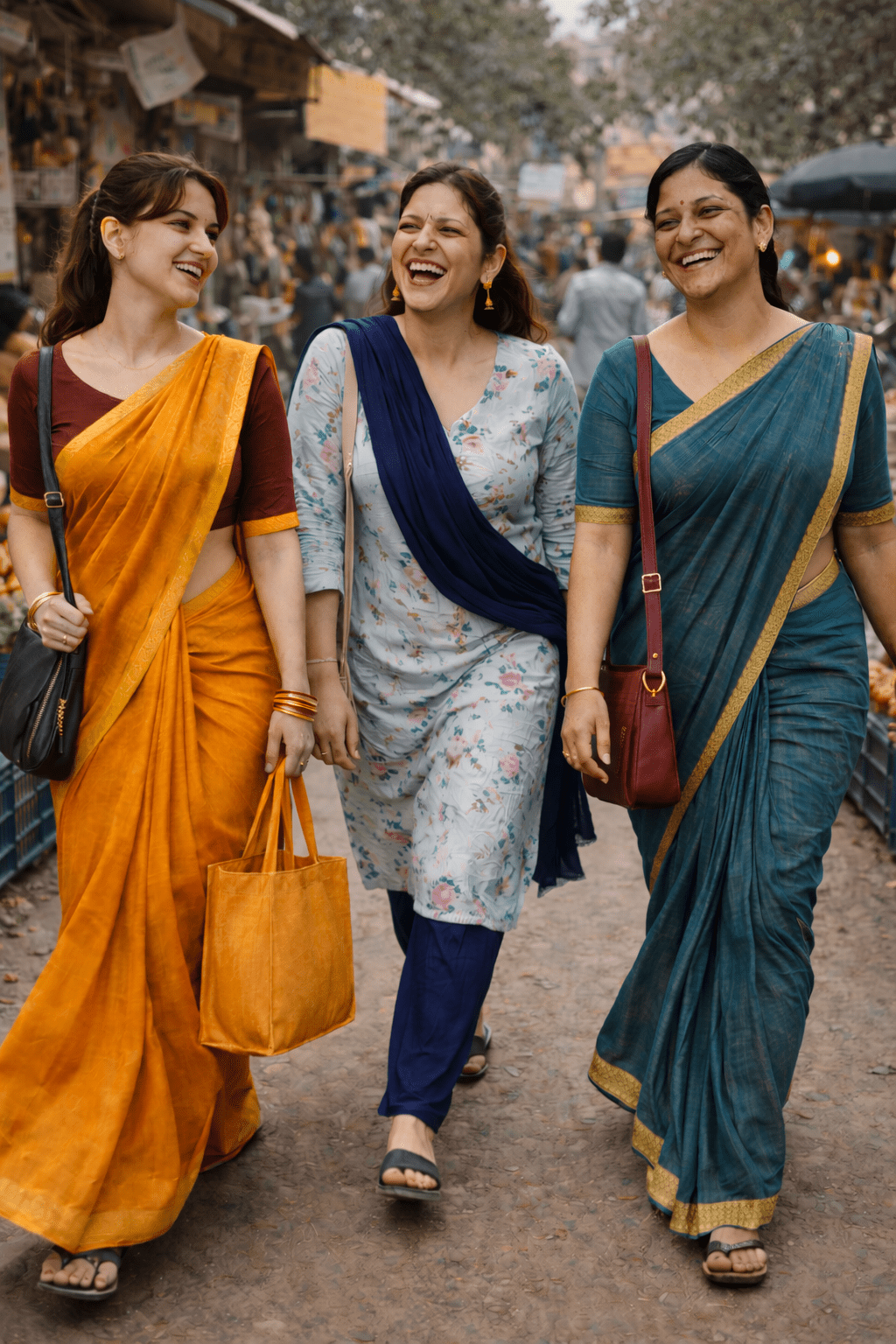
    When Meena mentioned needing vegetables for dinner, Sheela brightened. “We should all go to the market tomorrow. I can drive.”

    After lunch, as plates were stacked and hands washed, Sheela leaned back against the counter. “You know,” she said, “I’m impressed.”

    Lakshmi looked up. “By the cooking?”

    “By everything,” Sheela said.

    Lakshmi smiled, not trusting herself to answer too quickly.

    The afternoon didn’t pause just because something had been decided.

    After Meena left, Lakshmi rinsed the last plates, wiped the counter until it looked untouched again, and returned to the small rhythms that kept the house from slipping—one more load folded, rice rinsed for dinner, a quick sweep through the living room where sunlight showed dust too clearly.

    She took Parvathi’s late-afternoon meeting in the other room, camera off, voice steady, the way she always kept it when Parvathi might walk past the door.

    By the time evening arrived, the balcony light had turned soft and orange. Lakshmi reheated sambhar, made some more palya and set the table before Parvathi’s key even turned in the lock.

    Parvathi stepped in, shoulders loosening as soon as she saw Lakshmi.

    “Smells good,” she said, dropping her bag near the sofa.

    Lakshmi took it automatically and hung it in its place. “You must be hungry. Go wash your face.”

    Parvathi did, and when she returned, her eyes went to the food, then back to Lakshmi.

    “Today felt long,” she admitted, sitting down. “But coming home to this… it fixes something.”

    Lakshmi poured water into her glass. “Eat first,” she said. “Then you can complain properly.”

    Parvathi laughed, but it came out tired.

    Dinner was unhurried. Lakshmi told her about Meena—how easily she had said yes to lunch, how quickly she had settled at the table like she belonged there. She told her about Sheela being on the terrace, about laundry, about small building gossip that Parvathi didn’t really need but seemed to like hearing anyway.

    She did not mention the lesson.

    When they were done, Parvathi stayed at the table while Lakshmi cleared plates. She didn’t pick up her phone. She watched Lakshmi move around the kitchen in that competent way that was beginning to feel ordinary.

    “So,” Lakshmi said finally, drying her hands. “Sheela wants to take us to the market tomorrow.”

    Parvathi’s expression shifted—interest first, then something quieter underneath it. “The big one?”

    Lakshmi nodded.

    Parvathi leaned back in her chair. “That’s… your first time, isn’t it? Proper crowd.”

    Lakshmi could have brushed it off. She didn’t.

    “Yes,” she said. “And I know it’s a big deal.”

    Parvathi stood up and went to the cupboard without thinking. She slid sarees aside with quick familiarity, then paused, fingers hovering like she was weighing something more than fabric.

    “If you’re going,” she said, “we should choose properly.”

    Lakshmi followed her into the bedroom.

    Parvathi pulled out one saree, then another, holding each against Lakshmi’s shoulder the way she had done on the first day—except now it wasn’t an experiment in her hands. It was planning.

    “Not this,” Parvathi murmured, folding one back. “Too light. It’ll cling if you sweat.”

    She tried another and shook her head again. “Too bright. It’ll make you feel watched.”

    Then she reached deeper and brought out a saree Lakshmi hadn’t worn yet.

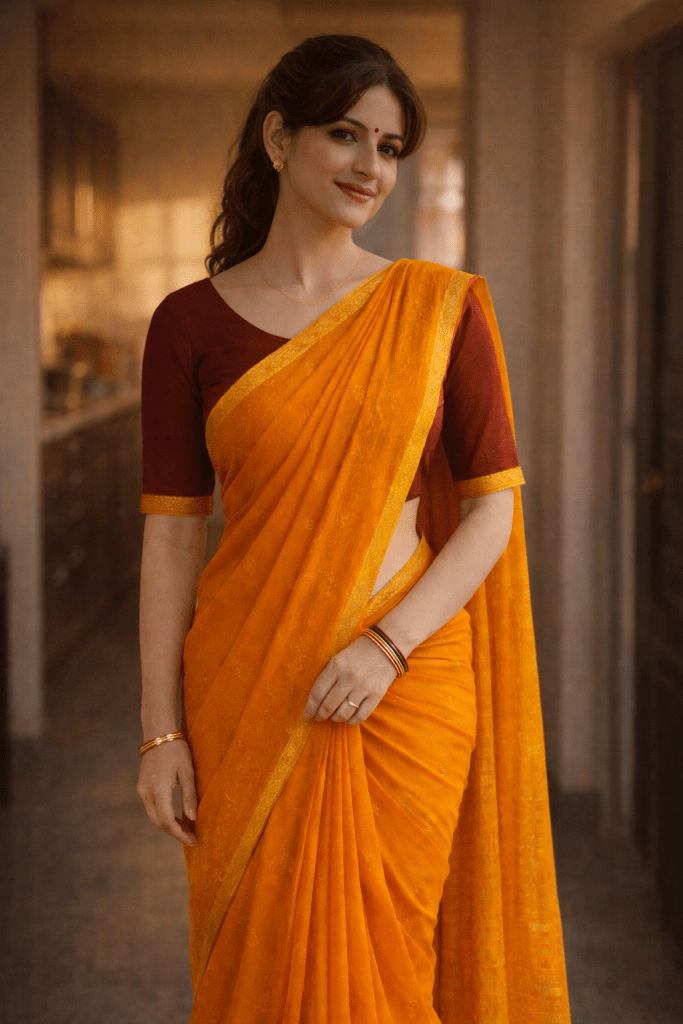
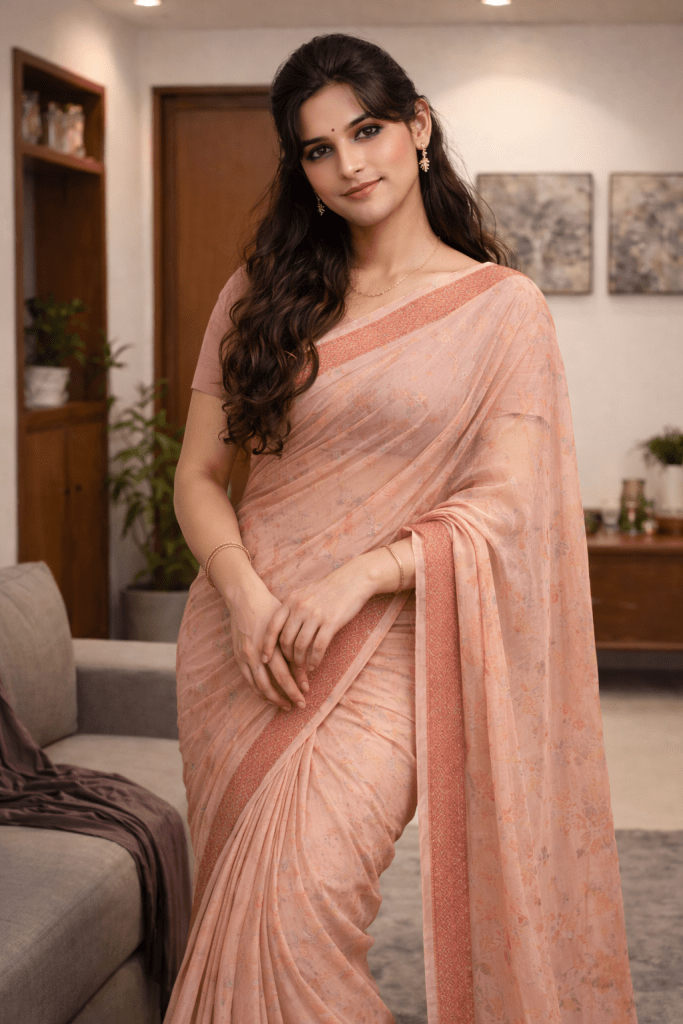
    The saree is a warm marigold–orange drape with a soft, matte finish, likely a lightweight cotton–silk or art silk blend. Subtle self-woven floral motifs are scattered across the body, adding texture without breaking the solid tone. The border is narrow and refined, edged in a muted gold that gives just enough contrast.

    Parvathi held it up, tilted her head, and nodded once. “This.”

    She went to the blouse pile and pulled out a muted gold blouse—simple, structured, the color echoing the border.

    Lakshmi touched the saree lightly, feeling the cotton under her fingers. “It’s nice,” she said.

    Parvathi didn’t smile right away. She looked at Lakshmi instead.

    “Are you sure you’re okay with this?” she asked. The question was quiet, but it carried weight. “Going out like that. Not the terrace, not the corridor. Public.”

    Lakshmi met her eyes. “I’m sure.”

    Parvathi exhaled. “I just…”

    She looked away, busying her hands with folding the saree again, but her voice softened. “I wish I could be with you.”

    Lakshmi stepped closer. “I know.”

    She reached for Parvathi’s hand. “But Sheela will be there. Meena too, if she comes. And it’s only the market. It’s not a stage.”

    Parvathi’s fingers tightened around hers. “Still.”

    Lakshmi squeezed back. “Nothing will happen,” she said. “And if anything feels wrong, I’ll leave. I’ll come home. I promise.”

    Parvathi nodded, slowly, as if the promise gave her something solid.

    She set the folded saree on the bed like a decision made. “Okay,” she said. “Tomorrow.”

    Lakshmi watched it there—marigold–orange, a refined border, the muted gold blouse beside it—and felt the day tilt forward again, not toward something bigger than she had planned, but toward something she had agreed to.

    Outside, the building settled into its night sounds—distant TV, a pressure cooker whistle somewhere, someone’s laughter drifting down a stairwell.

    Parvathi reached out and brushed her thumb once over Lakshmi’s knuckles, as if checking she was still there.

    “Sleep early,” she said. “Tomorrow will be… a lot.”

    Lakshmi nodded. “Tomorrow will be fine.”

    Parvathi didn’t let go of her hand.

    Lakshmi turned their joined fingers over, palm to palm, and felt the small roughness at Parvathi’s thumb—evidence of a day spent gripping a pen, a steering wheel, a phone. Ordinary proof.

    “Come,” Lakshmi said.

    They moved without switching on the main light, letting the dim spill from the hall do the work. In the bedroom, Parvathi sat at the edge of the bed and watched Lakshmi undo the tightness of her day—unpinning hair, loosening bangles, sliding the last clip free like a final exhale. The room felt quieter with each small removal.

    Lakshmi climbed onto the bed and leaned into Parvathi’s shoulder. For a moment they stayed like that, breath settling, bodies finding the shape they already knew.

    Parvathi’s hand slid to Lakshmi’s waist, warm and sure, and Lakshmi felt herself soften—not with performance, not with rehearsal, but with being held the way she wanted.

    “You were… so good today,” Parvathi murmured, the words pressed into her hair.

    Lakshmi lifted her head just enough to meet Parvathi’s eyes. “You mean the poha?”

    Parvathi’s smile was tired but unmistakably pleased. “I mean you.”

    Lakshmi kissed her then—slow, unhurried, like there was nowhere else to go. Parvathi answered the kiss with a quiet sound Lakshmi felt more than heard, and the rest of the room slipped out of focus.

    What followed wasn’t just good anymore—it was revelatory. They moved together with an intimacy that felt entirely new, as if the days of Lakshmi becoming herself had unlocked something in both of them. Parvathi touched her differently now, with a hunger and tenderness that made Lakshmi’s breath catch. There was no mechanical distance, no familiar routine. Just two women discovering each other in a way that felt both thrilling and deeply right.

    When they finally stilled, breathing hard, Parvathi pulled Lakshmi close with a fierceness that spoke louder than words. “God,” she whispered against Lakshmi’s neck. “I didn’t know it could be like this.”

    Neither had Lakshmi. The transformation she’d undergone wasn’t just external—it had changed what they could be to each other, opened doors she hadn’t known existed.

    Later, when the fan clicked to a lower speed and the sheets had been tugged into new, imperfect lines, Parvathi lay on her back, one arm flung above her head the way she slept when she had nothing left to guard. Her face held the kind of satisfaction that came from being truly, completely fulfilled.

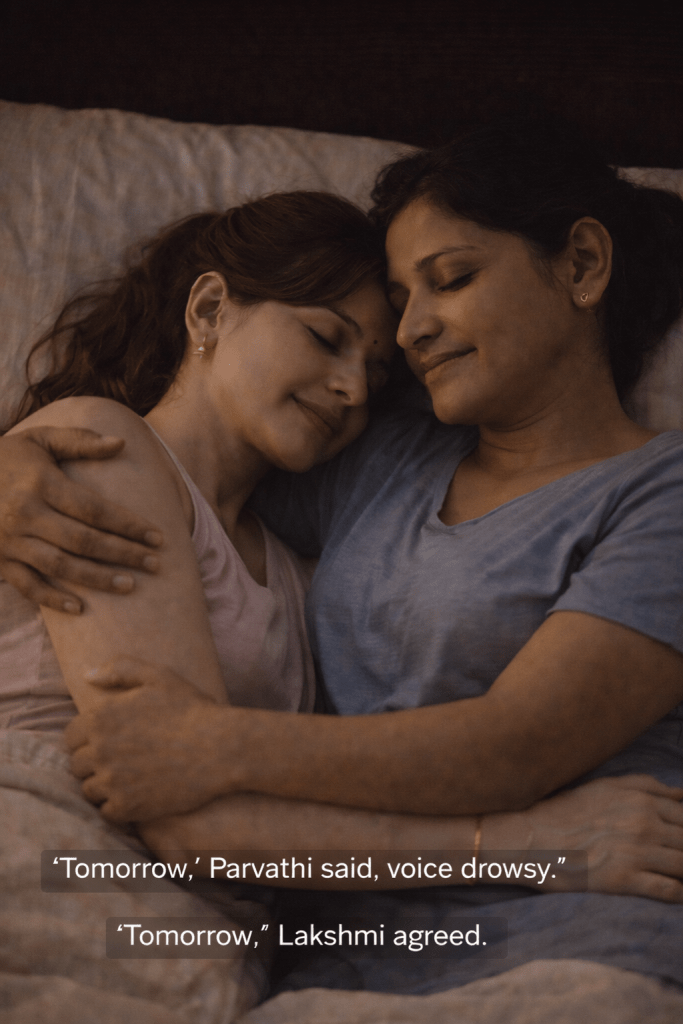
    Lakshmi rested against her side, listening to the building’s night noises fade one by one. Parvathi’s fingers traced lazy circles along her shoulder, as if still checking—still marveling at what they’d just shared.

    “Tomorrow,” Parvathi said, voice drowsy.

    “Tomorrow,” Lakshmi agreed.

    She closed her eyes with a satisfied heaviness in her limbs, the kind that made courage feel less like a decision and more like something her body already understood. And beneath that satisfaction lay something else: the knowledge that their intimate life had gone from struggling to excellent, and this was only the beginning.

    <- Previous Chapter | All Chapters

  • The Experiment – Chapter 3

    The Experiment – Chapter 3

    <- Previous Chapter | All Chapters | Next Chapter ->

    Monday: Lakshmi’s Debut

    Parvathi woke me gently.

    She went to the wardrobe and pulled out a cotton saree, pale green with a thin border. She held it up briefly, then handed it to me.

    “You can pick something else if you want,” she said. “Whatever you’re comfortable with.”

    I took it. The fabric was cool, familiar in my hands.

    She asked me to try draping it myself. I let the pleats come out uneven, adjusted the pallu once too many times. Parvathi stepped in without comment, straightening a fold, tucking the fabric firmly at my waist.

    “Don’t fight it,” she said. “Let it fall.”

    When she finished, the saree settled around me properly. As I moved, the fabric responded—brushing my legs, tightening slightly when I turned, loosening when I stood still. It asked for awareness, not effort.

    She helped with light makeup next—kajal, lipstick, nothing more. Her fingers were practiced. When she stepped back, she nodded once.

    Then she asked, casually, “How will you manage work dressed like this?”

    “I’ll just turn off the camera,” I said.

    She accepted that immediately.

    Inside, I remembered other mornings—this same table, the same laptop—when the camera stayed off and my voice stayed neutral. Parvathi didn’t know those mornings. She didn’t need to.

    “I’ll take care of breakfast,” I added. “You get ready.”

    She smiled, relieved, and went to change.

    In the kitchen, the saree moved with me. When I bent, the pleats tightened just enough to slow me. When I reached up, the fabric shifted at my shoulder. I adjusted without thinking.

    Tea. Toast. Something small.

    After we ate, Parvathi gathered her things. At the door, I followed her out—something Vishnu would never have bothered with if he were staying back. I handed her the packed lunch, reminded her about the meeting she’d mentioned the night before, wished her a good day. She smiled, a little surprised, then left.

    When the door closed, I stood there for a second, listening to her footsteps fade.

    Then I went back inside and stopped in front of the full-length mirror.

    I checked myself once, twice. Then—quietly—I laughed, lifted the pallu in one hand, turned in a twirl. A small, contained dance, nothing dramatic. Just enough to let the excitement out before it spilled.

    I opened the calendar next. Meetings marked in blocks. I moved a few reminders, penciled in breaks—one for lunch, another to finish dinner prep early. There were still a few open hours. Enough time to take care of things. The doorbell rang mid-morning.

    Amazon.

    Normally, dressed like this, I would have stayed still and silent, let them leave the package outside. I stood there for a moment, heart ticking faster than necessary. Then I walked to the door and opened it.

    The delivery boy handed over the parcel. I signed—Lakshmi—thanked him, and heard my voice as it came out. Softer. Feminine. The one I’d practiced alone, carefully, over months. No one else had ever heard it. Not even Parvathi.

    He nodded, smiled, left.

    I set the package down and exhaled.

    After my first meeting, I went back into the kitchen. I tucked the pallu firmly at my waist—the way women do when they’re ready to get things done—and cooked enough for both lunch and dinner. Efficient. Planned.

    Lunch was light. I’d always been careful about food—enough to stay energetic, never enough to put on weight. Cardio to stay slim, no heavy lifting to avoid building muscle that would look out of place. Standing there, eating quietly, I realized all of that discipline showed. That was why I looked the way I did.

    The hips—those had no explanation. Genetics, maybe.

    For a moment, I wished I had real breasts. The thought came and went. I didn’t linger.

    I went to the bedroom, opened a drawer Parvathi didn’t know about. A small collection of clip-on earrings—better ones than what Sheela had brought. I tried a few, studied myself, then put them back. Too risky. What if I forgot to switch later?

    I wore Sheela’s again.

    After another meeting, I looked around the house. When Vishnu dressed up in secret, he’d usually disappear into videos, into isolation. Today felt different. There was a pull toward the house itself.

    The floor needed vacuuming. Table needed wiping. Dust clung to the window grills—something we rarely got around to. I started with the vacuum, moving room to room. Thirty minutes, done.

    The windows were next. As I wiped them down, I worried briefly about being seen. Then I remembered—I didn’t need to hide. I opened each window fully, working carefully so the saree wouldn’t brush against grime.

    In the next building, a man sat reading the newspaper. He looked up, noticed me, raised a hand. I waved back. That was all.

    My heart beat faster for a moment. He must be new; I didn’t recognize him. It didn’t matter.

    By the time I finished, the light had shifted. I washed my face, refreshed the makeup lightly, retucked the saree so it fell just right. I wanted to look put together when Parvathi came home. Not dressed up—ready.

    Monday — Evening (revised, detailed) Parvathi came home tired.

    I saw it the moment she stepped inside—the way her shoulders dipped, the way she loosened her grip on her bag before even setting it down. I went to her immediately and took it from her hands before she had to ask.

    “Sit,” I said. “I’ve got it.”

    She didn’t argue. Instead, she leaned in for a second, resting her forehead lightly against my shoulder, arms coming around me in a brief, unthinking hug. It wasn’t dramatic. Just instinctive. Then she exhaled and pulled back.

    “Long day,” she murmured.

    “Sit for a minute,” I said again.

    She sank into the sofa, shoes kicked off, eyes closed. I hung her bag, straightened it, then turned back just as she opened her eyes and looked around properly. The floor. The table. The way nothing seemed to have a thin layer of dust the way it usually did by evening. She frowned slightly, then smiled.

    “You’ve been busy,” she said, half to herself.

    I didn’t respond. I was already moving toward the kitchen.

    From the sofa, she murmured, almost absentmindedly, “Thank you… I love you.”

    The words landed softly, without ceremony.

    She went to the restroom to freshen up. I took out dinner, set the plates, reheated everything so it would be just right. When she came back, tying her hair up loosely, she inhaled and smiled again.

    “I’m so hungry,” she said. “Thank you for keeping everything ready, my dear wife.”

    The words were casual. Almost teasing. But they stayed with me.

    We ate together, talking about her day—office politics, someone missing a deadline, an unnecessary meeting that could have been an email. I listened, asked questions, refilled her water.

    At one point I mentioned, lightly, “A guy from the next building waved at me while I was cleaning the windows.”

    She paused mid-bite, then laughed. “Oh? New neighbor?”

    “Must be,” I said. “I didn’t recognize him.”

    She shrugged. “Good. Be friendly.”

    After dinner, we settled on the couch and watched television together. Nothing important. Something familiar. She leaned into me without thinking about it, head resting against my shoulder, her legs tucked up.

    She didn’t notice the windows. It was dark by then anyway. Whatever expectations she’d had for the day, I’d already exceeded them.

    When we got ready for bed, she handed me another nightdress—soft, pretty, chosen with intention.

    “We’ll need to shop for more,” she said casually. “Sarees I have plenty. Nightdresses—barely enough for both of us for a week.”

    I smiled. “Don’t worry. I’ll wash them in a couple of days. We won’t run out.”

    She looked at me, mock-offended. “Girls need to shop. Why are you taking that away from me?”

    I laughed, and she did too.

    We went to bed in good spirits. The day had done its work quietly, thoroughly. Being tired together, relaxed together, did something to us. It wasn’t dramatic. It was just… good.

    That night felt different from Saturday’s distracted fumbling. We moved together with more presence, more attention. Parvathi seemed more relaxed, and I found myself less anxious, more focused on her. The mechanical distance from before had softened into something warmer—comfortable but present, familiar but engaged.

    It wasn’t passionate or earth-shattering. Just… consistently good. Connected. The kind of intimacy that doesn’t announce itself but leaves you both feeling closer when it’s done.

    As we settled into sleep, her hand found mine under the covers and stayed there.

    Another day, done right.

    <- Previous Chapter | All Chapters | Next Chapter ->

  • The Experiment – Chapter 2

    The Experiment – Chapter 2

    <- Previous Chapter | All Chapters | Next Chapter ->

    Sunday: Pretty, But Inconclusive

    Sheela paused at the door before leaving. “I’ll come by tomorrow afternoon,” she said. “After the dress-up. Call me if you need any help.”

    Parvathi nodded easily. “I will.”

    Sheela smiled at me, the way people do when they think they’re being part of something interesting but harmless. “Get some sleep.”

    After she left, the house slipped into its usual rhythm. Dinner was quiet, functional. We talked about small things—what to make the next day, a meeting Parvathi had—but the conversation never quite settled. Tomorrow sat there, unspoken.

    That night was worse than usual.

    We reached for each other out of habit, but my mind kept running ahead, and Parvathi noticed immediately. We didn’t say anything about it. Our sex life had been… fine for a while. Comfortable. Predictable. Tonight, the anxiety made it clumsier, distracted. Neither of us complained. We both knew why.

    Sleep came late and lightly.

    The alarm went off at five.

    Parvathi was already awake.

    “Come on,” she said. “We need time.”

    In the bathroom, she didn’t hover or touch—she gave instructions instead, leaning against the doorframe like a coach.

    “Take your time. Everywhere. Arms, legs, chest. Don’t miss under the arms. Or behind the knees.”

    I nodded and stepped into the shower.

    When I came out, towel around my waist, reaching for the razor, she stopped me.

    “Wait. Shave the beard only.”

    I looked at her.

    “You have a slight shadow here,” she said, touching just above my lip. “Waxing works better.”

    I hesitated. “Waxing hurts.”

    She smiled. “A little. And it grows back. This one’s gentle.”

    She pulled out a small container. “No strips. Just paste and peel. It’s meant for the face.”

    I winced, but nodded. The sting was brief, sharper in anticipation than reality. When she handed me the mirror, the skin looked cleaner than I’d ever managed with a razor.

    Before I could move on, she paused again.

    “Can I clean up your eyebrows?”

    I frowned. “I still have to go back to work.”

    “I know,” she said immediately. “Not thinning. Just cleanup. Strays here and there. Plenty of beautiful women have thick eyebrows.”

    I’d never dared to touch them myself for exactly that reason. I nodded.

    She worked carefully, conservatively. The change was subtle—but my face looked… finished.

    She blow-dried my hair next, combing it into place, shaping it gently. Feminine, but restrained. When she stepped back, she studied it like she was checking her own reflection.

    “Good,” she said.

    She insisted we stop for breakfast before continuing. Sitting at the table, eating normally, grounded the morning. It reminded me this was still our house, our routine.

    Then she stood up again. “Okay. Now we dress.”

    She wrapped the measuring tape around my chest. “Band size—same as me.”

    She handed me her bra. I hesitated, then put it on. She adjusted the straps, then added light fabric padding.

    “Enough to match mine,” she said.

    She held out panties.

    “I can wear my boxers,” I said quickly.

    She shook her head. “We’re not going for a costume. We’re trying to see how it feels. The inner experience counts.”

    I didn’t argue again.

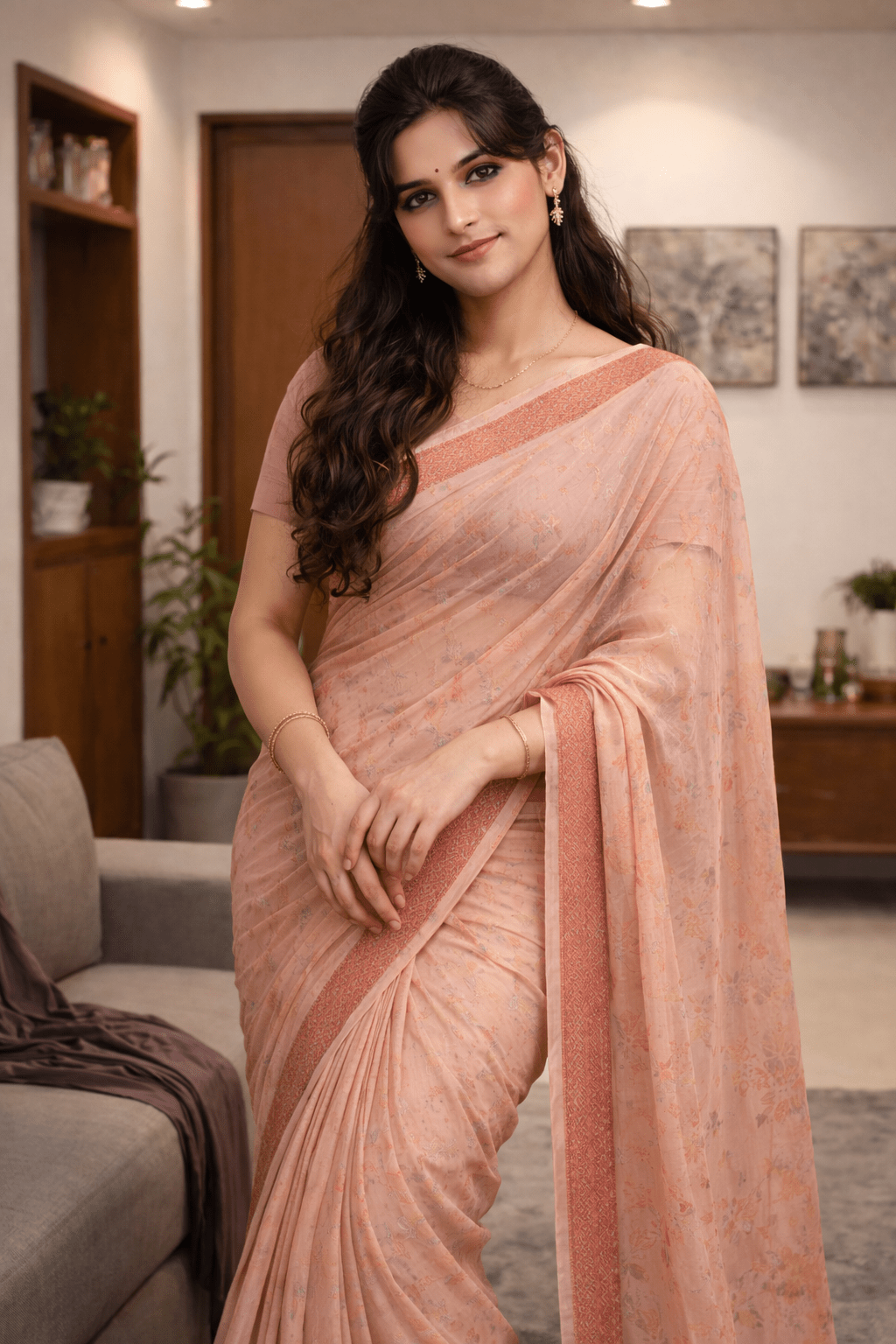
    She chose a chiffon saree—soft peach with a faint floral pattern that caught the light without demanding attention. The blouse piece was a matching muted rose. When she helped me into it, it fit without alteration, settling against my torso as if it had been meant for me.

    “This fabric forgives,” she said. “It flows.”

    She talked me through every step. The underskirt. The first tuck. The pleats—where to pull, where to release. I listened, asked questions I already knew the answers to, let her teach me. When she adjusted the fabric over my hips, she paused.

    “Your wider hip helps, Sheela was right” she said lightly. “The saree would look nicer on you than lot on women.”

    I’d known that. Maybe that was part of what had drawn me to this in the first place, long ago. Those years felt blurred now, indistinct, but the memory lingered in my body.

    She moved on to makeup. Mascara. Eyelash curler. A light sweep of color, lipstick chosen carefully. Concealer only where needed. It felt like a daily routine, not a performance.

    “You’ve taken good care of your skin,” she said. “It shows.”

    Jewelry came last. Thin bangles that made a soft sound when I moved. A simple neck chain that rested naturally at my collarbone. She paused, then sighed.

    “I don’t have clip-ons,” she said. “Only if we had more time.”

    When she finally stepped aside and let me look, something in me stilled.

    The person in the mirror wasn’t unfamiliar—but I’d never seen myself this complete. The saree fell perfectly. My face looked softer, cleaner, finished. The weight of the fabric, the quiet pressure of the bangles, the way everything held together—it all landed at once.

    I felt it in my chest first. Then everywhere.

    Parvathi watched my reflection rather than my face.

    That look—whatever crossed me in that moment—made her smile slowly.

    “Good,” she said. “That’s what I wanted.”

    And standing there, fully dressed, I knew the day had already crossed a line there was no rehearsing for.

    By the time lunch was done, the saree had stopped demanding attention.

    I cooked without thinking about it—rice first, then vegetables—moving between stove and sink with small, careful adjustments. The pleats stayed put. The pallu didn’t slip or get in the way. At some point, Parvathi leaned against the doorway and watched.

    “You’re handling the saree really well,” she said.

    I glanced down. “Am I?”

    “Yes,” she said simply. “You’re not fidgeting. You’re not checking it every few minutes. And your movements—”

    She paused, studying me.

    “They’re slower. But clean. Elegant. You’re not rushing into things.”

    I hadn’t noticed it myself, but once she said it, it felt true. Even bending to pick something up, even turning at the sink—my body seemed to move with intention rather than momentum.

    In the evening, Sheela arrived as promised. She took one look at me and smiled.

    “Well,” she said, amused, “that worked better than expected.”

    Her eyes drifted to my ears. “No earrings?”

    Parvathi shook her head. “No clip-ons.”

    “I can go back and get mine,” Sheela offered. “It won’t take long.”

    I hesitated, then nodded. When she returned, she handed them over with a grin. “Temporary arrangements.”

    They sat me down again—not to interrogate, not to tease. Curious, methodical.

    “So,” Sheela said, “do you feel any different?”

    I thought carefully before answering. I still didn’t suddenly know everything women knew. There were gaps. Plenty of them.

    Parvathi listened, then shook her head. “That’s not the whole picture. Today felt easier.”

    Sheela looked at her.

    “In the kitchen,” Parvathi continued. “We worked together without getting in each other’s way. No explaining. No irritation. It felt like two women moving in tandem.”

    I replayed the day in my head and nodded slowly. In retrospect, she was right.

    Sheela smiled. “That matters.”

    They exchanged a look.

    “So the experiment didn’t fail,” Parvathi said. “It needs time.”

    “At least another week,” Sheela added.

    I hesitated just enough to make it believable. “Another week?”

    “Academic rigor,” Parvathi said lightly.

    “Fine,” I said.

    Sheela leaned back in her chair. “Perhaps another reason for the incongruence is that we’re treating Vishnu as a man in a saree. That’s not a clean setup.”

    Parvathi tilted her head. “You’re right. We need a woman’s name.”

    Sheela’s face brightened. “What about Lakshmi?”

    Parvathi smiled immediately. “Yes. Let us call her Lakshmi. An elegant housewife. And she/her pronouns at all times. It’s important we use the right parameters.”

    Sheela laughed. “Agreed.”

    They both looked at me.

    Lakshmi didn’t feel like something I had to reach for. It was already there.

    “She,” I said.

    After Sheela left, the house settled again. Parvathi and I cleaned up together, moving easily, without discussion.

    Later, as we got ready for bed, she handed me a nightdress—cotton, soft, simple, but unmistakably feminine.

    “Not pajamas,” she said.

    I changed quietly. As I removed the clip-on earrings, I winced.

    “These hurt,” I said.

    Parvathi smiled, thoughtful. “We’ll find a better solution.”

    That night surprised both of us.

    There was no awkwardness, no distraction. Just closeness. Ease. A presence we hadn’t felt in a long time. Parvathi pulled me closer, almost startled by how natural it felt.

    Afterward, she rested her head against my shoulder and laughed softly. “I didn’t expect this.”

    Neither had I.

    As the room fell quiet, I realized she wasn’t just accepting the woman I was becoming.

    She was beginning to want her there.

    <- Previous Chapter | All Chapters | Next Chapter ->

  • The Experiment – Chapter 1

    The Experiment – Chapter 1

    All Chapters | Next Chapter ->

    Saturday Evening: Men Don’t Understand

    I walked in halfway through the sentence.

    “Men don’t understand these things,” Sheela was saying. “Doesn’t matter how many times we explain.”

    Parvathi was leaning against the table, arms folded, amused rather than angry. “That’s true. Vishnu is actually quite considerate. But I also think he just nods along more than he understands.”

    I stopped near the doorway. “What do I not understand?”

    Parvathi didn’t miss a beat. “You don’t get why this table has to be here, do you?”

    I glanced at the table—slightly awkwardly placed near the TV unit. “You wanted it there,” I said. “And you refused to explain last time.”

    “That’s exactly what I mean,” she replied. “If I have to explain every small thing, I lose all my energy.”

    I frowned. “Hey—Sheela, do you know why it’s there?”

    Sheela tilted her head, considering. “When you clean behind the TV unit, you need a place to keep the jars off the floor.”

    Parvathi smiled, triumphant. “See? A woman can tell right away. You only see where things are placed. You don’t see how everything moves around during the course of our lives.”

    “I would’ve known,” I said, a little defensively, “if I had cleaned that area before.”

    Parvathi laughed. “By that logic, Sheela must have cleaned here before. No. It’s instinct. You cook often, but you still don’t know where anything is kept.”

    “That’s because you buy things and keep moving them around,” I protested.

    “You will never get it,” she said, not unkindly.

    Sheela stepped in, voice calm, teacherly. “Why do you think that is? I’m sure Vishnu is trying his best. Even my husband—no clue what’s going on in the house.”

    Parvathi shrugged. “Maybe it’s genetic.”

    I snorted. “That’s a lazy answer. It has to be the role. It can’t just be genes.”

    Sheela nodded slowly. “It’s more than duties. Even if you cook every day for a week, your perspective won’t change. My husband volunteers sometimes. At the end of the week, I still have to deal with the mess that week created.”

    Parvathi’s eyes lit up—not mischievous, just curious. “Maybe there’s another way to get there. A full role change. Not just taking over tasks. Actually… embodying it.”

    Sheela leaned forward. “That’s interesting. But how do you force embodiment?”

    Parvathi turned to me then. “Vishnu—what do you think about dressing in a saree?”

    The room shifted.

    “It would keep reminding you that you’re a woman,” she continued, practical as always. “Not just doing things—being in the role.”

    Sheela nodded. “Ah. So the costume anchors the responsibility.”

    “Exactly,” Parvathi said. “Let’s dress up Vishnu.”

    “Hello,” I said quickly. “Don’t I get a say in this?”

    “Of course,” Parvathi replied. “Just once. Academic curiosity. Maybe we’ll prove it really is genetic.”

    My stomach tightened.

    Oh no.

    I had worn her sarees in secret. Carefully. Quietly. When I work from home and Parvathi is at work. I knew I would look nice without much effort, that is why I even kept longer hair and a clean shave. But nothing more.

    Now she was asking me—openly.

    If I resisted too much, this offer would disappear.

    If I agreed too easily, it would raise questions.

    I chose hesitation.

    “Really?” I said. “The only thing I have going for me is long hair. I’ll look ridiculous. Like a college prank. Not a role—just a joke.”

    Sheela laughed. “No way. You’re so slim it’s almost unnatural for a man. Those hips—if I saw you from behind, I wouldn’t assume anything. You’d look beautiful.”

    Parvathi smiled, appraising me openly now. “And that face. If your only worry is how you’ll look, we’re fine.”

    “What else should I worry about?” I asked.

    She studied me. “Honestly? I thought you’d say something irrational just to escape. But this is solvable.”

    “I’ll be a good husband without this,” I said, making one last attempt.

    She clasped her hands together. “Pretty please?”

    I hesitated just long enough to be convincing.

    “Fine,” I said. “Do as you wish.”

    Sheela clapped softly. “This is going to be fascinating.”

    Parvathi was already standing up, decision made.

    And just like that, the argument about a table became something else entirely.

    Later that night, we went through the motions of intimacy—familiar, routine, the kind that happens because that’s what couples do on a Saturday night. But my mind kept circling back to tomorrow, to the saree waiting in the wardrobe, to the way Parvathi had looked at me when she said “pretty please.”

    She noticed. Of course she noticed.

    “You’re distracted,” she said, pulling back slightly.

    “Sorry,” I said, trying to focus.

    We continued, but it felt mechanical, disconnected. Neither of us said anything about it afterward. We just turned to our sides of the bed, the space between us wider than usual.

    It had been like this for a while now—not bad, exactly. Just… fine. Comfortable in the way that meant we’d stopped really trying. The kind of fine that you don’t notice until something shifts and makes you look back.

    As I lay there in the dark, I wondered if tomorrow’s experiment would change anything.

    Or if it would just be another curiosity that faded back into routine.

    All Chapters | Next Chapter ->