<- Previous Chapter | All Chapters
Wednesday: Three Women
Lakshmi woke before the alarm, the room still cool with early light. Parvathi slept on, one arm flung across the pillow, breathing deep in a way that meant she could afford another few minutes. Lakshmi watched her for a moment, then leaned in, pressed a soft kiss to her forehead.
“You sleep a bit more,” she whispered. “I’ll keep everything ready.”
She slipped out of bed quietly.
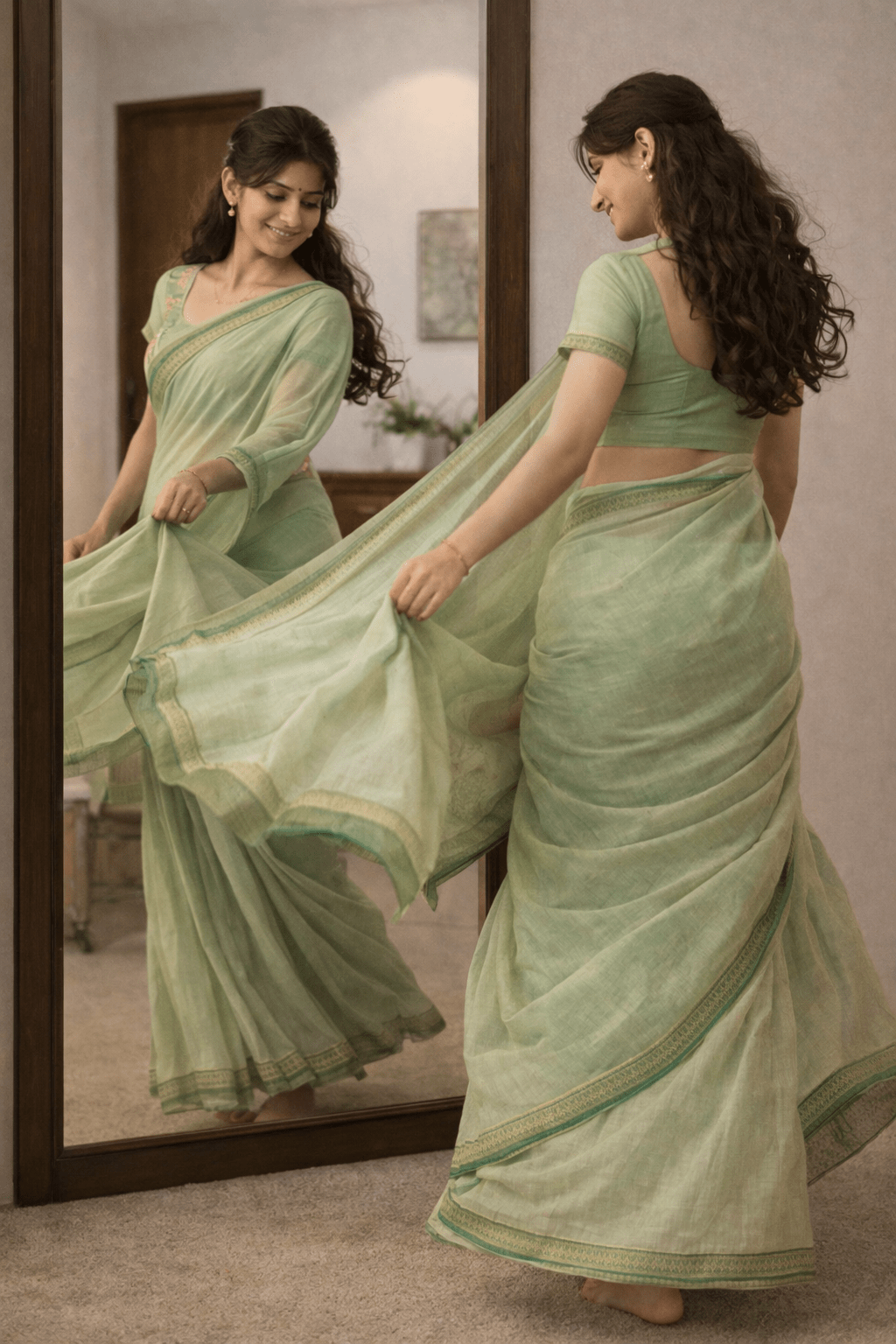
At the cupboard, she paused longer than necessary. Wednesdays were not ceremonial days—no visitors expected, no errands planned yet. She chose a saree that matched that mood: a light polyester, pale green with a faint, repetitive pattern. Easy to drape, forgiving if she had to move fast, the kind of saree meant to disappear into the day rather than announce itself. The blouse was plain, short-sleeved, already familiar to her body.
The shower was quick. Shaving was automatic now—underarms, legs, face—done without conscious thought. She dried her hair, tied it back loosely, and draped the saree with practiced efficiency. Two rehearsals, she reminded herself. Enough to justify competence, not enough to invite questions.
In the mirror, she adjusted the pallu, smoothing it across her shoulder. This saree didn’t demand elegance; it allowed motion. Good for what she had planned.

In the kitchen, she started breakfast. Poha today—light, fast. As mustard seeds crackled in oil, she checked the fridge.
We should make some tomorrow, she thought. Good to have variety.
She added it to the mental list forming already: batter, groceries, laundry, dinner prep.
While the poha steamed, she packed lunch—leftover sambhar, palya warmed gently, and a note to fry papad later before boxing it. By the time everything was ready, sunlight had spilled fully into the bedroom.
Lakshmi went back, sat on the edge of the bed, and brushed Parvathi’s hair away from her face.
“It’s time,” she said softly.
Parvathi stirred, smiled even before opening her eyes. “Already?”
Lakshmi nodded. “Breakfast is ready.”
Parvathi disappeared into the bathroom. When she came back, towel around her shoulders, she stopped short at the dining table.
“Oh,” she said. “Poha?”
“And eggs,” Lakshmi said, turning from the stove. “Lunch is packed too.”
Only then did Parvathi really look at her.
The indigo of yesterday was gone; this was quieter, domestic. The saree sat easily on Lakshmi’s frame, the pallu already tucked once at the waist, as if she had things to do and places to move through.
Parvathi stepped closer and wrapped her arms around Lakshmi from behind. “I should have married you years ago.”
Lakshmi laughed, nudging her gently. “Let me finish this first. Then you can hug.”
Parvathi showered, dressed, and came back ready for work. They ate together, unhurried. Parvathi talked about meetings; Lakshmi listened, nodded, filed away times and moods.
“You know,” Parvathi said finally, standing up to leave, “it feels like you’ve always lived here like this.”
Lakshmi walked her to the door, handed over the lunchbox, adjusted the strap of Parvathi’s bag.
“Have a nice day,” she said.
When the door closed behind Parvathi, Lakshmi stood still for a moment—then turned back toward the house that was now hers for the day.
Lakshmi didn’t sit down after the door closed. She stood in the hallway for a second, listening to Parvathi’s footsteps fade, then moved straight into the rhythm of the house.
Calendar first.
She opened it on her phone, scanning the day. Two meetings in the morning, one in the late afternoon. Nothing urgent in between. Enough open space to do something real.
Laundry.
She went to the bedroom and pulled out the baskets. One glance was enough to know what needed priority. Night dresses first—too many had been worn over the weekend, and she had promised herself she wouldn’t let them pile up again. Cotton sarees next. Kitchen towels. Bedsheets could wait; those didn’t need sun today.
She sorted with care, hands moving automatically, but her mind stayed engaged. Some fabrics could take harsh sunlight; others needed shade to keep their color. A few delicate pieces she set aside entirely.
Sun is strong today, she thought. Better to use it.
She loaded the machine with the first batch—nightwear—measured detergent without checking the label, set the cycle, and moved on to the next pile while it ran.
Between loads, she took her first meeting, camera off, voice steady and neutral. She answered when needed, took notes, listened more than she spoke.
When the washing finished, she didn’t dump everything together. She hung the shade-safe clothes near the balcony first, spacing them carefully so air could move through. Saree pallus draped neatly, not twisted. Night dresses placed where they’d dry fastest.
The terrace pile grew in a separate basket: cotton sarees, towels, heavier linens.
I really need a trolley for this, she thought, lifting the basket slightly to test its weight. Or wheels.
She added it to the list.
Before heading up, she adjusted her saree—pallu tucked securely at the waist this time, pleats tightened. This was work, and her clothes reflected that. She carried the basket carefully, aware of balance, aware of the fabric brushing against her legs as she climbed.
The terrace door opened into bright sunlight.
Sheela was already there.
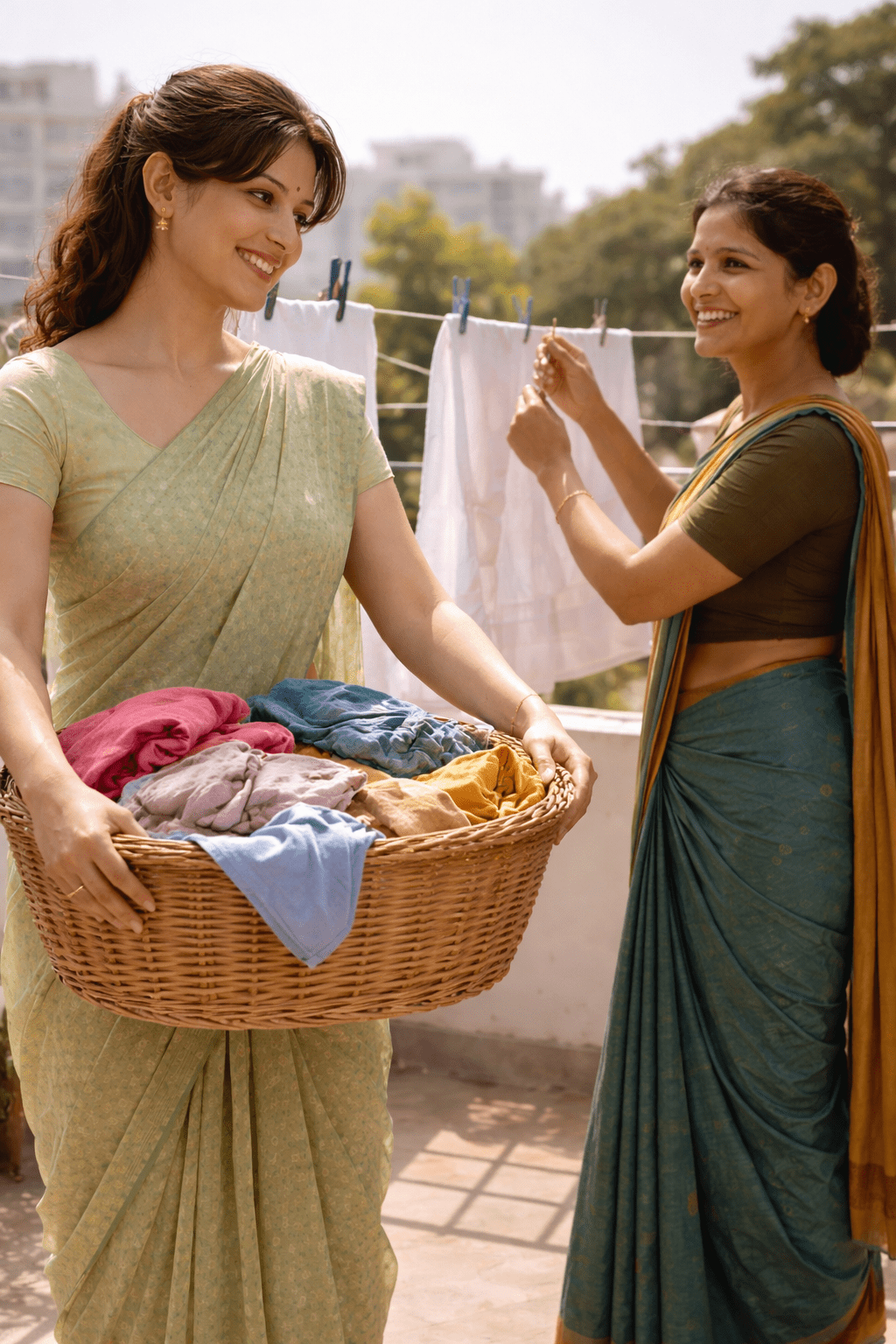
Sheela stood near the railing, pinning up clothes with practiced speed, her own saree tied back almost identically. She looked up and smiled.
“Good morning,” she said. “Laundry day?”

Lakshmi smiled back. “Perfect weather for it.”
She set the basket down and began hanging the first saree, smoothing it before fixing the clips. Sheela watched her for a moment longer than necessary.
“You know,” Sheela said casually, “everything about you looks so convincing now.”
Lakshmi paused, then continued pinning. “Convincing?”
“Mm,” Sheela nodded. “The way you move. Even that”—she gestured to the tucked pallu—“that’s how women who actually work around the house do it. Not for show.”
Lakshmi felt a quiet warmth spread through her chest. “Thank you.”
Sheela leaned against the railing. “Honestly, if someone saw you here like this, they wouldn’t think twice. You look like every other housewife I’ve grown up watching.”
They worked side by side for a few minutes in silence, the rhythm familiar, domestic, unremarkable in the best way.
Then Sheela tilted her head slightly. “There’s just one thing.”
Lakshmi felt it before Sheela said it.
“Your voice,” Sheela continued gently. “Everything else has fallen into place so fast. But your voice still… sounds like Vishnu.”
Lakshmi’s hands didn’t stop moving. “Yeah?”
“If you want,” Sheela said, “I can help. It’s not hard. Just small shifts.”
Lakshmi hesitated—only for a second. “I’m willing to learn,” she said. “What do I need to do?”
Sheela smiled. “Good. First—relax your throat. Don’t push. Try saying this…”
And just like that, between sarees and towels, the lesson began.
They worked as Sheela spoke.
“Don’t try to sound higher,” Sheela said, pinning a bedsheet. “That’s the mistake most people make. Just let the sound come forward.”
Lakshmi nodded, repeated the sentence Sheela gave her. Slowly. Carefully.
“No, slower,” Sheela said. “And don’t finish it so sharply. Let it trail a bit.”
Lakshmi tried again. The words felt different leaving her mouth this way—lighter, less pushed. She adjusted without thinking, like she always did when copying someone else’s rhythm.
“That’s better,” Sheela said. “Again.”
They hung more clothes. Towels. A cotton saree. Kitchen cloths flapped in the breeze as Lakshmi repeated phrases, each time correcting something small—breath, pace, softness.
“Relax your jaw,” Sheela added. “You’re holding tension there.”
Lakshmi exhaled, tried again.
This time Sheela smiled. “There. Did you feel that?”
Lakshmi did. She nodded.
They moved along the line, sunlight warming their backs. The lesson didn’t pause the work; it flowed with it. Instructions came between clothespins, corrections slipped in while walking to the next railing.
“You’re picking this up too fast,” Sheela said after a while, laughing. “You’re dangerous.”
Lakshmi smiled, careful not to overdo it. “I used to do a lot of mimicry in college,” she said lightly. “Actors, politicians… all male ones. This felt familiar.”
“Well,” Sheela said, satisfied, “then I’m just giving you the final polish.”
Lakshmi thanked her, sincerely. She didn’t mention the hours she’d spent alone, whispering into mirrors, adjusting syllables no one else ever heard. She was happy to let Sheela own the moment.
By the time the last cloth was hung and they gathered the empty basket, Lakshmi noticed something quietly remarkable.
She wasn’t trying anymore.
They walked back toward the stairwell together, Sheela chatting about nothing in particular, and Lakshmi answering—naturally, easily, her voice settling into place as if it had always known where to rest.
At the door, Lakshmi paused. “Have you met Meena yet?” she asked.
Sheela shook her head. “The new neighbor?”
“Yes,” Lakshmi said. “She’s just downstairs. Thought I’d introduce you.”
Sheela smiled. “Lead the way.”
Meena opened the door with a smile that came easily, the kind that suggested she was still trying to keep flat numbers and names straight.
“Oh hi!” she said.
“Meena – hi!” Lakshmi said, just as easily. “This is Sheela from 306.”
Meena’s smile widened. She shifted her attention to Sheela. “Nice to meet you! I was hoping to meet more people in the building.”

They stepped inside for a moment, the doorway becoming a small circle of conversation.
Meena spoke about unpacking, about how everything she needed seemed to be in the wrong box. Sheela chimed in with advice—where to find the best vegetables, which shops delivered late, which days the water pressure dipped.
Lakshmi listened, added a detail here and there, answered a question about the building association. Her voice stayed where it had settled upstairs—calm, forward, unremarkable.
Meena didn’t pause or blink. To her, Lakshmi was exactly who she appeared to be: another woman in the building, competent, friendly, already part of the quiet network that made a place feel livable.
“You should come for lunch sometime,” Lakshmi said before thinking too hard about it. “Today, if you’re free. Nothing fancy.”
Meena looked genuinely pleased. “I’d love that.”
Sheela nodded. “Perfect. Saves me from figuring out what to cook.”
Back in Lakshmi’s kitchen, things fell into place quickly. The sambhar was already simmering; she added a second palya, fried papad while the rice steamed. Plates appeared on the table without ceremony.
They ate together, the conversation drifting—work, children, neighbors, how strange it felt to start over somewhere new. Lakshmi moved easily between kitchen and table, refilling glasses, clearing plates, her presence steady rather than showy.
At one point, she held her phone up and snapped a quick photo of the three of them, smiling mid-meal. She sent it to Parvathi without comment.

The reply came almost immediately.
Oh no. You’re all meeting without me? Total FOMO. Say hi to Meena from me.
Lakshmi smiled, typed back, then slipped the phone away.
When Meena mentioned needing vegetables for dinner, Sheela brightened. “We should all go to the market tomorrow. I can drive.”
After lunch, as plates were stacked and hands washed, Sheela leaned back against the counter. “You know,” she said, “I’m impressed.”
Lakshmi looked up. “By the cooking?”
“By everything,” Sheela said.
Lakshmi smiled, not trusting herself to answer too quickly.
The afternoon didn’t pause just because something had been decided.
After Meena left, Lakshmi rinsed the last plates, wiped the counter until it looked untouched again, and returned to the small rhythms that kept the house from slipping—one more load folded, rice rinsed for dinner, a quick sweep through the living room where sunlight showed dust too clearly.
She took Parvathi’s late-afternoon meeting in the other room, camera off, voice steady, the way she always kept it when Parvathi might walk past the door.
By the time evening arrived, the balcony light had turned soft and orange. Lakshmi reheated sambhar, made some more palya and set the table before Parvathi’s key even turned in the lock.
Parvathi stepped in, shoulders loosening as soon as she saw Lakshmi.
“Smells good,” she said, dropping her bag near the sofa.
Lakshmi took it automatically and hung it in its place. “You must be hungry. Go wash your face.”
Parvathi did, and when she returned, her eyes went to the food, then back to Lakshmi.
“Today felt long,” she admitted, sitting down. “But coming home to this… it fixes something.”
Lakshmi poured water into her glass. “Eat first,” she said. “Then you can complain properly.”
Parvathi laughed, but it came out tired.
Dinner was unhurried. Lakshmi told her about Meena—how easily she had said yes to lunch, how quickly she had settled at the table like she belonged there. She told her about Sheela being on the terrace, about laundry, about small building gossip that Parvathi didn’t really need but seemed to like hearing anyway.
She did not mention the lesson.
When they were done, Parvathi stayed at the table while Lakshmi cleared plates. She didn’t pick up her phone. She watched Lakshmi move around the kitchen in that competent way that was beginning to feel ordinary.
“So,” Lakshmi said finally, drying her hands. “Sheela wants to take us to the market tomorrow.”
Parvathi’s expression shifted—interest first, then something quieter underneath it. “The big one?”
Lakshmi nodded.
Parvathi leaned back in her chair. “That’s… your first time, isn’t it? Proper crowd.”
Lakshmi could have brushed it off. She didn’t.
“Yes,” she said. “And I know it’s a big deal.”
Parvathi stood up and went to the cupboard without thinking. She slid sarees aside with quick familiarity, then paused, fingers hovering like she was weighing something more than fabric.
“If you’re going,” she said, “we should choose properly.”
Lakshmi followed her into the bedroom.
Parvathi pulled out one saree, then another, holding each against Lakshmi’s shoulder the way she had done on the first day—except now it wasn’t an experiment in her hands. It was planning.
“Not this,” Parvathi murmured, folding one back. “Too light. It’ll cling if you sweat.”
She tried another and shook her head again. “Too bright. It’ll make you feel watched.”
Then she reached deeper and brought out a saree Lakshmi hadn’t worn yet.
The saree is a warm marigold–orange drape with a soft, matte finish, likely a lightweight cotton–silk or art silk blend. Subtle self-woven floral motifs are scattered across the body, adding texture without breaking the solid tone. The border is narrow and refined, edged in a muted gold that gives just enough contrast.
Parvathi held it up, tilted her head, and nodded once. “This.”
She went to the blouse pile and pulled out a muted gold blouse—simple, structured, the color echoing the border.
Lakshmi touched the saree lightly, feeling the cotton under her fingers. “It’s nice,” she said.
Parvathi didn’t smile right away. She looked at Lakshmi instead.
“Are you sure you’re okay with this?” she asked. The question was quiet, but it carried weight. “Going out like that. Not the terrace, not the corridor. Public.”
Lakshmi met her eyes. “I’m sure.”

Parvathi exhaled. “I just…”
She looked away, busying her hands with folding the saree again, but her voice softened. “I wish I could be with you.”
Lakshmi stepped closer. “I know.”
She reached for Parvathi’s hand. “But Sheela will be there. Meena too, if she comes. And it’s only the market. It’s not a stage.”
Parvathi’s fingers tightened around hers. “Still.”
Lakshmi squeezed back. “Nothing will happen,” she said. “And if anything feels wrong, I’ll leave. I’ll come home. I promise.”
Parvathi nodded, slowly, as if the promise gave her something solid.
She set the folded saree on the bed like a decision made. “Okay,” she said. “Tomorrow.”
Lakshmi watched it there—marigold–orange, a refined border, the muted gold blouse beside it—and felt the day tilt forward again, not toward something bigger than she had planned, but toward something she had agreed to.
Outside, the building settled into its night sounds—distant TV, a pressure cooker whistle somewhere, someone’s laughter drifting down a stairwell.
Parvathi reached out and brushed her thumb once over Lakshmi’s knuckles, as if checking she was still there.
“Sleep early,” she said. “Tomorrow will be… a lot.”
Lakshmi nodded. “Tomorrow will be fine.”
Parvathi didn’t let go of her hand.
Lakshmi turned their joined fingers over, palm to palm, and felt the small roughness at Parvathi’s thumb—evidence of a day spent gripping a pen, a steering wheel, a phone. Ordinary proof.
“Come,” Lakshmi said.
They moved without switching on the main light, letting the dim spill from the hall do the work. In the bedroom, Parvathi sat at the edge of the bed and watched Lakshmi undo the tightness of her day—unpinning hair, loosening bangles, sliding the last clip free like a final exhale. The room felt quieter with each small removal.
Lakshmi climbed onto the bed and leaned into Parvathi’s shoulder. For a moment they stayed like that, breath settling, bodies finding the shape they already knew.
Parvathi’s hand slid to Lakshmi’s waist, warm and sure, and Lakshmi felt herself soften—not with performance, not with rehearsal, but with being held the way she wanted.
“You were… so good today,” Parvathi murmured, the words pressed into her hair.
Lakshmi lifted her head just enough to meet Parvathi’s eyes. “You mean the poha?”
Parvathi’s smile was tired but unmistakably pleased. “I mean you.”
Lakshmi kissed her then—slow, unhurried, like there was nowhere else to go. Parvathi answered the kiss with a quiet sound Lakshmi felt more than heard, and the rest of the room slipped out of focus.
What followed wasn’t just good anymore—it was revelatory. They moved together with an intimacy that felt entirely new, as if the days of Lakshmi becoming herself had unlocked something in both of them. Parvathi touched her differently now, with a hunger and tenderness that made Lakshmi’s breath catch. There was no mechanical distance, no familiar routine. Just two women discovering each other in a way that felt both thrilling and deeply right.
When they finally stilled, breathing hard, Parvathi pulled Lakshmi close with a fierceness that spoke louder than words. “God,” she whispered against Lakshmi’s neck. “I didn’t know it could be like this.”
Neither had Lakshmi. The transformation she’d undergone wasn’t just external—it had changed what they could be to each other, opened doors she hadn’t known existed.
Later, when the fan clicked to a lower speed and the sheets had been tugged into new, imperfect lines, Parvathi lay on her back, one arm flung above her head the way she slept when she had nothing left to guard. Her face held the kind of satisfaction that came from being truly, completely fulfilled.
Lakshmi rested against her side, listening to the building’s night noises fade one by one. Parvathi’s fingers traced lazy circles along her shoulder, as if still checking—still marveling at what they’d just shared.
“Tomorrow,” Parvathi said, voice drowsy.
“Tomorrow,” Lakshmi agreed.
She closed her eyes with a satisfied heaviness in her limbs, the kind that made courage feel less like a decision and more like something her body already understood. And beneath that satisfaction lay something else: the knowledge that their intimate life had gone from struggling to excellent, and this was only the beginning.