<- Previous Chapter | All Chapters | Next Chapter ->
Tuesday: My Wife
I woke up before the alarm. Parvathi was still asleep, one arm flung carelessly across the pillow, her breathing slow and even.
I leaned over, kissed her forehead lightly, and whispered, “You sleep a bit more. I’ll keep everything ready.”
She stirred but didn’t wake, a faint smile forming before settling back into sleep.
I went straight to the cupboard and stood in front of the sarees for a moment. Yesterday had been careful, tentative. Today felt… normal.
I chose an indigo cotton saree—simple, breathable, the kind meant for daily life—and found the matching blouse without thinking too much about it. Natural fabric. Practical. Comfortable.
The routine followed easily. Shower. Shave. Nothing rushed, nothing indulgent.
I draped the saree myself, movements steady. After two rehearsals, doing it decently didn’t feel suspicious anymore—just expected.
I checked the pleats once, adjusted the pallu, tied my hair back neatly.
A thin line of kajal. Minimal concealer. Nothing else.
In the kitchen, I set about breakfast and lunch together. Upma for the morning, stirring patiently until the texture felt right.
I reheated leftover palya and sambhar for the lunch box, adding a couple of fried papads on the side—something small, but it would make the meal feel complete.

Once everything was on the stove or packed away, I went back to the bedroom. I leaned down again, kissed Parvathi’s cheek this time. “It’s time to get ready for office,” I said softly. She opened her eyes slowly, blinking up at me. “Already?” I smiled. The sun had begun to filter in through the curtains, lighting the room gently. She hadn’t really seen me yet—not properly.
She went to brush, then the bathroom. I stayed in the kitchen, finishing up, moving plates to the table. When she came out again, she stopped short. Upma and boiled eggs were laid out neatly. I was at the stove, reheating the last bit of sambhar, the indigo saree falling cleanly around me.
She came up behind me and wrapped her arms around my waist, resting her chin briefly on my shoulder. “I should have married Lakshmi years ago,” she said, laughing softly. I felt my face warm. “I have to finish this,” I said, pretending to focus on the stove. “Then you can hug.” She laughed again and let go, heading back to get dressed.
By the time she returned—fully ready for office—we sat down together for breakfast. She watched me for a moment before speaking. “You know,” she said, “the saree looks perfect on you. And the house—it’s like you’ve always lived this way.” I looked down at my plate, then back up at her.
We ate slowly, unhurried. The day had barely begun, but something had already shifted—not loudly, not dramatically. Just enough to feel right.
Once Parvathi left, the house slipped back into its weekday rhythm.
I opened the calendar and scanned the day. Too many meetings—blocks stacked close together, hardly any breathing room until late afternoon. There would be some free time then, if things ran on schedule. I moved a couple of reminders, adjusted lunch slightly earlier, dinner prep later. Planning felt natural now, almost comforting.
Before the first meeting started, I paused in front of the mirror.
Not to check anything in particular. Just… to see.
I took a quick selfie, the indigo saree falling neatly, hair in place, neck chain catching a bit of light. I didn’t overthink it. I saved it in a folder I’d created the night before and named simply: Lakshmi.
Meetings took over. One flowed into the next. My voice stayed neutral, professional. Camera off. Notes taken. Action items assigned. Somewhere between calls, time slipped.
A message buzzed on my phone.
My lakshmikutty, had lunch? I loved that you put in papad for the lunchbox—it was such a nice touch 😘
I smiled before I realized I was hungry.
I replied with another selfie—this one casual, smiling a little more openly. Thank you for reminding me. Will just have some. Too many meetings today.
After a light lunch, I went back to the kitchen to start dinner prep. Halfway through, I reached for curry leaves and stopped. They were there—but wilted, tired-looking.
I considered stepping out. Then dismissed it. Changing back felt unnecessary, almost disruptive.
Just then, a familiar call rose from below—the vegetable truck.
I stepped onto the balcony. “One bunch curry leaves!” I called out. “And half kilo green beans.”
The vendor shouted his UPI ID. I paid quickly. He bundled the vegetables, tied the cover, and tossed it up neatly.
“Thank you, madam,” he called.
The word landed differently than I expected.
As I turned back inside, I noticed other balconies opening. Doors. Voices. Neighbors coming out, drawn by the same call.
Across from me, a woman stepped out—smiling, curious. She waved.
“Hi! I’m Meena,” she called. “We just moved in. Nice to meet you!”
I waved back. “Hi, I’m Lakshmi. I think I saw your husband yesterday—he was reading the newspaper on the balcony. When did you move in?”
“About a week ago,” she said. “He went to office today. We should hang out sometime! Have a nice evening!”
“Yes,” I replied easily. “See you!”
I went back inside, vegetables in hand, heart beating just a little faster than before.
Dinner prep resumed. The house settled again. But something had shifted—quietly, irreversibly—carried in by a single word, spoken without question.
A few minutes later, there was a knock at the door. I assumed it was delivery again. I wiped my hands, adjusted the saree at my waist, and opened it.
It was Meena.
“Sorry to bother you,” she said, a little breathless. “I just started cooking today and realized we’re out of so many things. Moving was a mess. I just need a bit of coriander powder and turmeric powder, if you have some.”
A familiar tightening settled in my chest. This was closer. More exposed. Not a balcony exchange or a shouted order from below. I took a breath and smiled. When I spoke, I used my best female voice—the one I had trained over years of solitude, of mirrors and empty rooms.
“Of course,” I said warmly. “Welcome to the neighborhood. You can come anytime. I just need to find a small box to put them in. We move everything into containers once it comes home.”
“No worries,” Meena said, already reaching into her bag. She produced two small containers, neat and cheerful. “I’ve got that covered.”
“Oh, that’s so cute,” I said without thinking, and took them from her. I filled them carefully, leveling the spoons, tapping gently so nothing spilled.
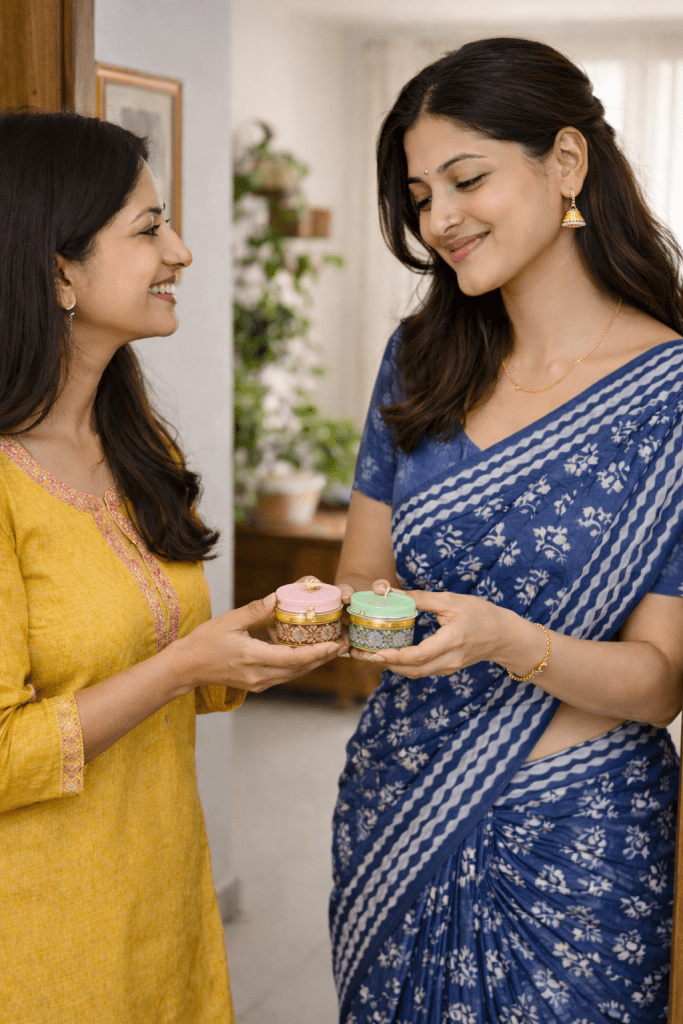
“Thank you so much,” she said, then paused. “Are you married?”
“Yes,” I replied easily. “My wife has gone to office too.”
The word landed fully formed before I could catch it.
Wife.
Not partner. Not friend. Not some careful, reversible term. Wife.
There was a heartbeat of silence. Then Meena’s face lit up.
“Wow, so cool,” she said. “You married a girl? I’ve never had a lesbian couple next door. This is going to be the best neighborhood ever.”
My mind raced—not panic, but calculation. Correcting her now would mean explanations. Calling her back would mean lies. Either way, the moment would stretch, awkward and unnecessary.
I smiled and gently steered away.
“Have you met Sheela in 306?” I asked. “She’s our other neighbor—always helpful if you need anything. Unlike us, she’s home most of the time. I’m working from home, you see.”
I thought briefly about how much explanation I was avoiding. How letting Sheela be the bridge might soften whatever truth eventually emerged.
“Oh nice,” Meena said. “I’m between jobs right now. It’s hard in this economy to have the luxury of staying home full time. But I do miss the intellectual workout.”
“Yeah,” I said, nodding. “Though managing a home can also be a lot of thought exercise.”
She laughed. “True. But our husbands are never going to appreciate it. At least your wife will see everything you do.”
Something shifted quietly inside me.
I thought of Parvathi noticing the wiped table. Thanking me for something so small. Never assuming it was my duty. Never letting the work disappear into expectation.
“Yeah,” I said softly. “I’m really happy to have her in my life.”
Meena smiled, tucked the containers back into her bag, and thanked me again before leaving.
When the door closed, I stood there for a moment longer than necessary.
I had said wife.
Out loud. To a neighbor.
And instead of the world tightening around me, it had… opened.
I finished cooking just as the light outside began to soften.
Everything was ready well before time, so I wiped the counters again, rinsed the cutting board, and waited.
Parvathi came home in a better mood than yesterday—lighter, less taxed by the day.
I took her bag the moment she stepped in. She hugged me, kissed me once, then again, lingering just a little longer.
“Today was better,” she said. “Not as draining.”
“That’s good,” I replied, guiding her toward the sofa. “Go freshen up. Food’s ready.”
When she came back, she noticed immediately.
“Green beans?” she asked, pointing. “I don’t remember us having these.”
I smiled. “That’s a whole story. Sit.”
She laughed and settled in as I told her everything—the vegetable truck, calling down from the balcony, Meena knocking, borrowing spices.
I told her about the containers, the conversation.
“And then,” I added, more quietly, “she asked if I was married. I said my wife has gone to office.”
Parvathi looked at me steadily.
“And?”
“She thought we were a lesbian couple,” I said. “She seemed… happy about it.”
Parvathi laughed out loud. “That’s it? You were worried about that?”
She reached across the table and squeezed my hand. “I married you. That’s all that matters. How anyone else understands it is their business.”
Dinner passed easily after that. Conversation flowed.
When I cleared the plates, she didn’t stop me. When I wiped the table, she watched, thoughtful.
Later, as the house quieted, something clicked into place.
This—this constant noticing, planning, anticipating—this was the invisible labor Parvathi had been doing all along. Not just cooking or cleaning, but remembering, adjusting, holding the household together without announcing it. And Vishnu—I—had barely seen it.
Now that I did, it was impossible to unsee.
After both of changed into our night dresses like usual. I was arranging the pillows when Parvathi’s voice broke the comfortable silence, a teasing lilt in her tone. Parvathi leaned into me easily, trusting, unguarded.
“You know,” she said, moving closer, “now that you’ve told everyone we’re lesbians, we should act accordingly.”
Before I could respond, she pushed me gently back onto the sofa, straddling me with a mischievous smile playing on her lips. Her hands found my face, cradling it softly.
“Parvathi—” I started, but she silenced me with a kiss.
It wasn’t gentle or tentative. It was passionate, claiming, full of everything we’d been dancing around all day.
Her fingers threaded through my hair, and I forgot to think about sarees or neighbors or experiments. There was only this—her weight on me, her lips on mine, the sound of our breathing mingling in the quiet room.
When she finally pulled back, both of us breathless, she whispered against my lips, “If we’re going to be the neighborhood’s lesbian couple, we might as well commit to the role.”
Something shifted in me—bold, certain.
I stood up smoothly, lifting her with me. She gasped, wrapping her legs around my waist instinctively, arms circling my neck.
“Lakshmi!” she laughed, surprised and delighted.
I carried her toward the bedroom, her weight familiar and right in my arms, her laughter warming something deep inside me.
As I crossed the threshold, I understood something clearly for the first time:
The experiment hadn’t changed who I was.
It had changed what I could finally see—and what I was willing to become.

 Stories by Iron Butterfly
Leave a comment